


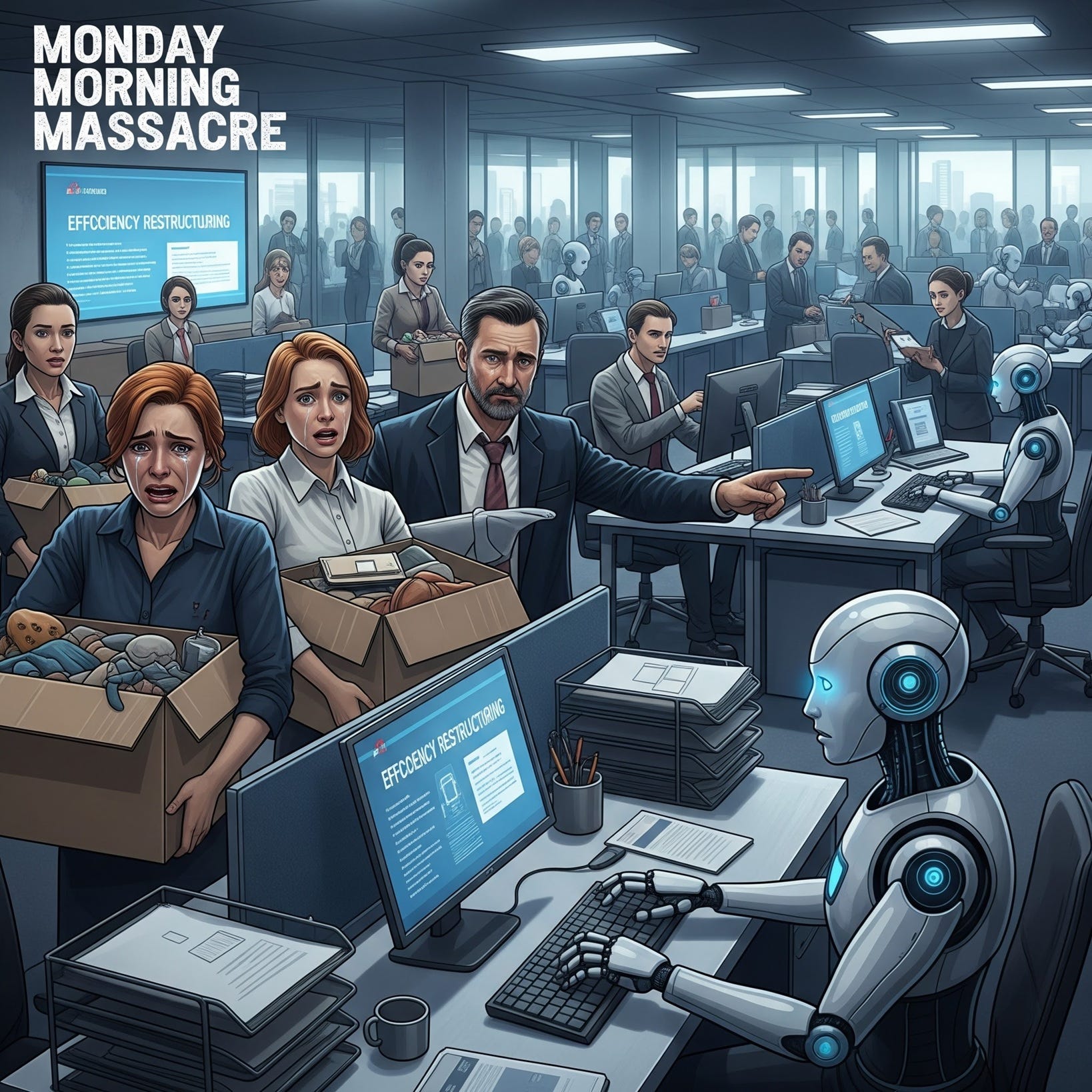
“It’s not about humans versus machines, but humans without machines versus humans with machines.” — Satya Nadella, Microsoft CEO
The Email That Arrived Like Clockwork
At 9:01 AM Eastern Time on an unremarkable Thursday, Accenture employees worldwide received an email with the subject line “Important: Workforce Transformation Update.” Within the corporate world, this has become as predictable as quarterly earnings: Thursday afternoon announcement, Friday stock bump, Monday morning execution. The pattern is so consistent that employees have created a website—LayoffWatch.io—that predicts with 73% accuracy which Fortune 500 company will announce “transformations” next.
This Thursday, it was Accenture’s turn. The consulting giant announced an $865 million restructuring program. Eleven thousand positions had been eliminated over the previous quarter, with more to follow. The criteria, stated with unusual candor: staff who “cannot be retrained for the age of artificial intelligence.”
Within minutes of the announcement, LinkedIn lit up with a familiar ritual. The pink slip posts, as they’re now called, follow a script everyone knows:
“After 12 incredible years at Accenture, I’m excited to announce I’m open to new opportunities...”
“Today marks the end of one chapter and the beginning of another...”
“While disappointed by today’s news, I’m grateful for the experience...”
Behind the corporate euphemisms and forced optimism, a darker truth emerges in the anonymous forums. On Fishbowl, an Accenture employee posted: “Sat through six hours of ‘AI transformation’ training last month. Scored 94%. Still got cut. The training was never about saving us—it was about teaching the AI our jobs before they fired us.”
The Mathematics of Human Disposal
The documents leaked to Business Insider reveal the algorithm’s cold logic. Accenture’s “Employee Optimization Model” evaluated workers across 147 variables, including:
Task automation potential (weighted 40%)
Salary-to-AI-cost ratio (30%)
Years to retirement (20%)
Client relationship dependence (10%)
Anyone scoring above 70 was marked for “transition.” The model showed 94% of data analysts, 87% of junior consultants, and 76% of project managers fell into the disposal zone.
A senior partner, speaking to the Financial Times on condition of anonymity, admitted what everyone suspected: “We knew eighteen months ago that AI could do most associate and analyst work. We delayed to extract maximum value from human workers while we trained their replacements. The humans literally built their own guillotines.”
The Global Synchronized Swimming
This isn’t random or company-specific. It’s coordinated, deliberate, industry-wide. Reuters investigation revealed the “Thursday Protocol”—an informal agreement among major firms to announce layoffs on Thursday afternoons, allowing bad news to dissipate over weekends while stock prices rise on efficiency gains.
The Pattern, Now Institutionalized:
Week 1: Company A announces, stock rises 3-5%
Week 2: Company B follows, citing “industry transformation”
Week 3: Company C joins, noting “competitive pressures”
Week 4: Reset, next industry begins
One McKinsey partner told the Financial Times: “Nobody wants to be first, but nobody can afford to be last. When Accenture moved, we knew our announcement was days away. It’s like synchronized swimming—everyone moves together, nobody takes sole blame.”
The Industry Reality Check
Recent Quarter’s Confirmed Changes:
Accenture: 11,000 positions eliminated
Reason given: “Cannot be retrained for age of AI”
Reality: AI tools replacing junior consultant work
Severance: Typically 8-12 weeks, contingent on NDAs
IBM: Progressing toward 7,800-job reduction target
CEO explicitly stated: “AI will replace repetitive white-collar work”
Focusing on HR and back-office functions
Replacing with Watson and automated systems
McKinsey & Company: Industry reports indicate significant restructuring
Launched “Lilli” AI platform for analytical work
Reduced entry-level hiring substantially
Partners increasingly managing AI systems rather than people
Deloitte, PwC, KPMG, EY: Various restructuring announcements
Audit work becoming increasingly automated
Tax preparation shifting to AI-driven processes
Advisory services using AI for initial analysis
The total impact extends beyond simple numbers. Each eliminated position represents decades of education, mortgages that continue regardless, children who still need college funds, retirements suddenly uncertain.
The Liquidation of the Middle
What’s being eliminated isn’t just jobs—it’s the entire middle tier of knowledge work. The pyramid structure that defined corporate life for a century is collapsing into an hourglass: a tiny top of executives and prompt engineers, a thin bottom of liability sponges and button-pushers, and nothing in between.
A post on r/consulting captured the new reality: “There are two kinds of jobs now: those that tell AI what to do, and those that take blame when AI fails. Everything else is gone. I’m paid $180K to essentially be liable for AI decisions. My actual work takes three hours a week.”
The consulting model that built the modern corporation—armies of analysts building PowerPoints, associates creating Excel models, managers quality-checking—is already obsolete. One client CEO told the Wall Street Journal: “I pay McKinsey $2 million for what ChatGPT gives me for $200. The only difference? I can sue McKinsey.”
Voices from the Affected
From Glassdoor and workplace forums (anonymized but representative):
“The cruel part? I trained the AI that replaced me. Spent months teaching it our frameworks, our methodologies, our client relationships. They called it ‘knowledge transfer.’ It was a suicide mission.”
“Got laid off from a major consulting firm. The partner said, ‘An AI agent can do the work of seven analysts.’ Then asked me to document my workflows before leaving. I asked why. He said, ‘To optimize the transition.’”
“Tech company, 12 years experience. Thought I was safe. Was told my entire team’s work could be done by AI with one PM supervising. The PM? Makes half what I did. The future of tech work is a few conductors leading orchestras of AI.”
“Our entire data science team was eliminated. Not because we weren’t valuable, but because automated ML platforms do our job faster and cheaper. The model we spent two years building? Rebuilt better in 48 hours by AI.”
These aren’t outliers—workplace forums overflow with similar accounts. The pattern is consistent: years of experience made irrelevant overnight, expertise devalued to zero, humans training their digital replacements.
The Ripple Becomes a Tsunami
Each tech layoff eliminates approximately 2.5 additional jobs in the ecosystem. The coffee shop near Accenture Tower Chicago closed after losing 70% of morning customers. The dry cleaner servicing Amazon’s Seattle campus shut down. Food trucks that fed Google employees dispersed.
A small business owner near Meta’s campus told the San Francisco Chronicle: “Tech workers were our economy. When they disappear, we disappear. The AI that replaced them doesn’t buy lunch.”
The multiplier effect cascades:
Recruiters without anyone to recruit
Corporate trainers without humans to train
Office managers without offices to manage
HR professionals without human resources
Even luxury services are feeling it. A San Francisco real estate agent told the Wall Street Journal: “Tech workers were buying $2 million homes. AI doesn’t need housing. The entire Bay Area economy was built on high-paid humans. Without them, we’re Detroit 2.0.”
The Retraining Mythology
Every layoff announcement includes the same lie: opportunities for “reskilling.” The reality, documented in MIT’s study of corporate retraining programs:
90% of companies announce retraining
30% provide any actual training
10% of workers successfully transition
3% maintain comparable income
An Accenture employee posted their “generous reskilling package” on Twitter: “Coursera subscription (retail $399), LinkedIn Learning access (already had it), and an AI ‘career coach’ that’s just ChatGPT with a different logo. This is supposed to prepare me for jobs that don’t exist yet.”
The cruelest part: the skills being taught are already obsolete. One bootcamp instructor admitted on Hacker News: “I’m teaching prompt engineering to people laid off six months ago. By the time they graduate, AI will be writing its own prompts. We’re teaching them to be blacksmiths in the automobile age.”
The C-Suite’s Golden Parachutes
While thousands lose livelihoods, executives prosper. Accenture’s CEO received $31 million in compensation the same year as the layoffs. The board justified it as “successfully managing transformation.” Translation: firing humans profitably.
The pattern repeats everywhere:
IBM CEO: $18 million while cutting 7,800
Microsoft CEO: $48 million during layoffs
Alphabet CEO: $226 million amid 12,000 cuts
A private equity partner, speaking at a closed conference later leaked, was frank: “Every layoff announcement pumps the stock. Executives have equity. Do the math. They’re incentivized to fire as many as possible, as fast as possible. The more humans they eliminate, the richer they get.”
The View from Inside the Machine
Those who survive aren’t celebrating. Internal surveys leaked from major tech companies show:
73% actively job searching
81% report severe anxiety
92% believe they’ll be replaced within eighteen months
67% regret entering tech
One survivor at Google posted anonymously: “I made it through three rounds of layoffs. I’m not relieved—I’m terrified. Every day I wonder if I’m training my replacement. Every meeting about ‘AI integration’ is really about ‘human elimination.’ We’re dead workers walking.”
The psychological torture of survivors might be worse than being cut. They work alongside AI systems, knowing they’re being measured, optimized, evaluated for replacement. Every efficiency gain they create hastens their obsolescence.
The Next Wave Forming
As this chapter is written, the pattern continues:
Monday: Intel announces 15,000 cuts, stock rises 4% Tuesday: Cisco eliminates 7,000, praised for “efficiency” Wednesday: Qualcomm cuts 1,250, called “forward-thinking” Thursday: Next company’s turn Friday: Markets celebrate human disposal
The website DeadPoolTech.com now takes bets on which company announces next, which department gets eliminated, how many thousands lose jobs. It’s become spectator sport—human disposal as entertainment.
When Algorithms Dream of Labor
We’re not witnessing job displacement—we’re seeing the systematic dismantling of human economic participation. The infrastructure being built ensures that today’s massacre is tomorrow’s normal. Companies aren’t just using AI; they’re becoming AI with vestigial human components retained for regulatory compliance.
The trajectory is clear: organizations as intelligent systems that hire humans only when legally required. The concept of “employment” transforms from economic participation to temporary biological necessity until regulations catch up with capabilities.
A leaked Amazon planning document outlined their 2030 vision: “The optimal configuration is zero human workers. Until regulations permit full automation, we maintain minimum viable human presence for liability purposes. These positions should be designed for high turnover to prevent organization or wage pressure.”
We’re building toward enterprises that think at silicon speed, operate continuously, experience no loyalty or ethics except what’s programmed. The question isn’t whether humans will have jobs, but whether human-operated organizations can compete with intelligent enterprises that never sleep, never sick, never strike.
The Last Human Resources
What remains after the massacre isn’t employment—it’s a new form of economic serfdom. The jobs that survive share characteristics:
Liability absorption: Someone to blame when AI fails
Regulatory requirement: Laws mandating human presence
Emotional labor: Pretending to care about customer experience
Physical presence: Until robots improve
Creative fiction: Maintaining illusion of human involvement
These aren’t careers—they’re economic hospice care for a species being removed from its own economy.
Questions for the Terminated
As you read this, another thousand people are receiving their transformation notices. Another hundred companies are training AI on human workflows. Another algorithm is calculating the optimal moment to eliminate the trainers.
So ask yourself:
About Your Value:
What do you do that AI can’t—not yet, but truly can’t?
If your job could be done remotely, can it be done by AI?
Are you creating value or managing liability?
How many of your daily tasks could you automate today?
About Your Industry:
Is your company investing more in AI or human development?
When did they last hire versus last adopt AI tools?
What percentage of your colleagues’ work could AI do?
Who in leadership understands what you actually do?
About Your Future:
What’s your plan when the email arrives?
Can you compete with someone using AI assistance?
Would you hire yourself over an AI that costs 1/10th as much?
What will you do when your entire profession vanishes?
About Resistance:
Should there be limits on how many humans companies can replace?
Do we need new economic models for post-employment society?
Can democracy survive mass economic exclusion?
Who benefits from human disposal, and can they be stopped?
The Most Important Question: If AI can do your job better, faster, and cheaper than you, what is your economic purpose in a capitalist society that values only productivity and profit?
The answer to that question will determine whether humanity remains economically relevant or becomes a subsidized biological remnant in an economy operated by and for artificial intelligence.
The next Thursday announcement is already being drafted. The only question is whether your name is in the algorithm’s queue.
From the upcoming book: Framing the Intelligence Revolution- How AI Is Already Transforming Your Life, Work, and World: Chapter 4 documents the systematic elimination of human knowledge workers, the coordinated nature of mass layoffs, and the approaching end of employment as humanity has known it for centuries.
Legal Disclaimer: This chapter synthesizes publicly available information, published reports, and documented worker experiences as of October 2025. Company names are used for illustrative purposes based on public information. Views expressed represent analysis and commentary based on research, not legal or financial advice.
Regarding the article's insights on 'workforce transformation', I'm curious what steps you envision governments or even tech companies themselves taking to prevent such massive human displacement, especially for those who genuinely can't pivot to an AI-centric role? Your framing of the issue, particularly the Nadella quote and the 'humans without machines' aspect, is incrediby perceptive and really makes one think about the future of work and inclusion; thanks for this sharp analysis.