


By Dr. Elias Kairos Chen
CFOs privately expect AI layoffs to be 9x higher this year than last.
Last month, I sat across from a CEO who had just approved an AI transformation programme for his organisation. Halfway through our session, he paused and asked me a question I could not answer: “Am I training them for jobs that won’t exist by the time the programme finishes?” He was not being dramatic. He was doing the math.
That same week, a founder told me he had cut a significant portion of his workforce because AI made them unnecessary. His stock price surged. A government official told me her country’s reskilling programme was the most ambitious in the world. An economist told me there is no AI impact visible in any macroeconomic data. And a young graduate told me she had applied to hundreds of jobs and could not get a single interview because every entry-level role now requires years of experience she has no way to get.
All of them were telling the truth. That is the problem.
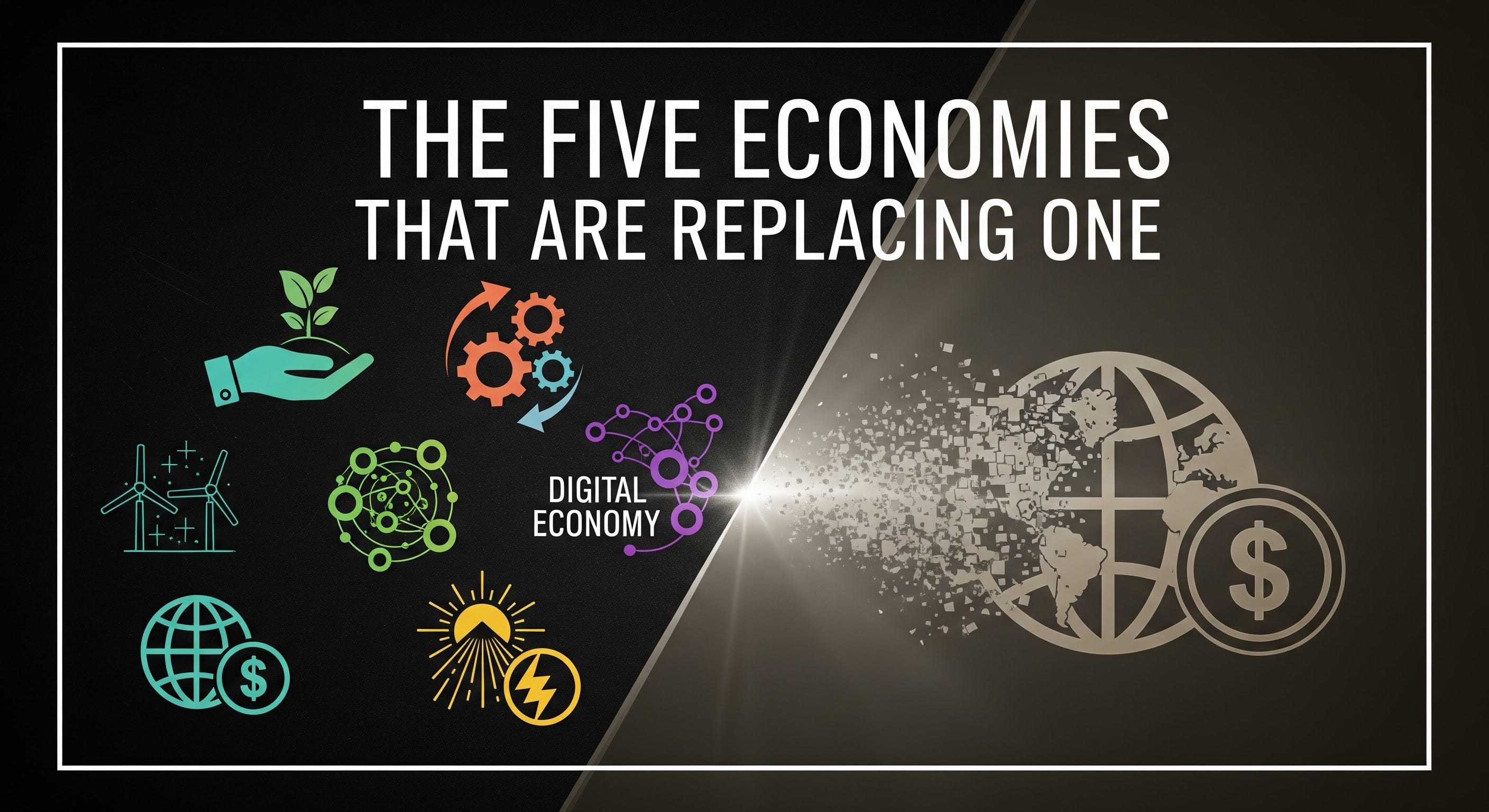
We are not living through one economy anymore. We are living through several, simultaneously, and the institutions we rely on to make sense of the world are each describing a different one.
The old economy and its single story
For three centuries, the economy told one story. Humans provide labour. Employers provide income. Income purchases goods and services. Governments tax the cycle. Banks lend against future earnings. Education prepares the young. Retirement rewards the old. The entire social contract, from mortgages to pensions to healthcare, is built on this single narrative: work, earn, spend, repeat.
This story survived every previous technological disruption because every previous technology, from the steam engine to the internet, automated tasks while leaving human capability as the scarce input. New tasks always emerged. New jobs always followed. The story held.
In Week 15, I examined how AI breaks this story by automating the capability itself, turning the scarce input abundant and driving its market price toward zero. Vinod Khosla described the destination: a world where today’s five-year-olds never need jobs. The labour-for-income model ends.
But the old economy is not simply ending. It is fragmenting. And the fragments are not replacing it with one new story. They are replacing it with five.
Economy One: The Automation Economy
This is the economy the markets see.
A founder cuts his workforce dramatically because AI made them unnecessary. His stock surges. Goldman Sachs notes the cuts target engineering roles. The company now targets quadruple the gross profit per employee it had before COVID.
The logic is clean, rational, and self-reinforcing. AI reduces headcount. Reduced headcount improves margins. Improved margins increase share price. Rising share price rewards the CEO and shareholders. Every other CEO watches and calculates: how fast can I do the same?
The World Economic Forum projects 92 million jobs displaced by 2030. McKinsey estimates current AI technology could automate 57% of U.S. work hours. Goldman Sachs projects 6-7% of the workforce displaced during the transition. These are not fringe estimates. These are the baseline assumptions of the most respected institutions in global economics.
But the Automation Economy is not evenly distributed. It concentrates in knowledge work, white-collar services, and digital production, the sectors where AI capability is most immediately applicable. It hits hardest at the entry level, where tasks are most standardisable and where the humans performing them have the least leverage to resist.
The young graduate who cannot get an interview lives in this economy. She is not unemployed because the economy is weak. She is unemployed because the entry-level role she was trained for has been absorbed into an AI workflow, and the remaining roles require experience she was never given the opportunity to develop.
Federal Reserve Bank of New York data confirms this is not anecdotal. Recent college graduates aged 22 to 27 face unemployment of 5.6%, compared to the overall rate of 4.2%. Tech employment as a share of the total economy has fallen steadily since November 2022. Unemployment among 20 to 30 year olds in tech-exposed occupations has risen nearly three percentage points since early 2025. The pipeline is constricting at the entry point, and the humans who would normally fill it are being locked out before they start.
And here is what makes this economy self-reinforcing: Autodesk’s CEO says openly that the company will hire fewer people because of efficiency. When you multiply that decision across thousands of companies making the same calculation, the aggregate effect on the entry-level labour market is structural, not cyclical. These jobs are not coming back when the economy improves. They are being permanently absorbed.
Economy Two: The Augmentation Economy
This is the economy the optimists describe.
IBM is tripling entry-level hiring for 2026. Its chief human resources officer rewrote every job description to shift junior roles away from automatable tasks and toward customer engagement, AI oversight, and complex problem-solving. “The companies three to five years from now that are going to be the most successful are those that doubled down on entry-level hiring in this environment,” she said.
Dropbox expanded its internship and graduate programmes by 25%, citing younger workers’ AI fluency as a competitive advantage. PwC also announced it would not automate basic tasks, instead redesigning roles to keep humans central. The WEF projects 170 million new jobs created by 2030, a net gain of 78 million even after displacement.
The Augmentation Economy believes AI makes humans more productive, not redundant. It redesigns work around human-AI collaboration. It invests in training, mentorship, and role transformation. It assumes the labour-for-income model survives if the nature of labour changes.
IBM’s bet is strategic: if you cut the pipeline now, you will have no mid-level managers or senior leaders in five years. The automation economy optimises for this quarter. The augmentation economy optimises for 2031. The tension between them will define the next decade.
But there is an uncomfortable truth the augmentation economy must confront. The market is rewarding the automation economy. Stock prices surge when companies cut. They do not surge when companies retrain. The financial incentive structure points in one direction, and it is not toward augmentation.
Economy Three: The Demographic Economy
This is the economy the labour economists describe.
Indeed and Recruit, operating across 60 countries with real-time hiring data, argue that demographics, not AI, define the labour market. Ageing populations in advanced economies mean we will have too few workers, not too many. Healthcare already accounts for a third of recent U.S. labour force growth. Care roles, delivery, construction, and frontline services face chronic shortages that AI cannot fill because they require physical presence, human empathy, or manual dexterity that current technology cannot replicate.
The WEF data supports this: the largest growing job categories include farmworkers, delivery drivers, building construction workers, nursing professionals, and social workers. These are roles where human physical and emotional presence remains essential.
The Demographic Economy says the AI displacement narrative is overblown. Yes, some knowledge work gets automated. But the real constraint is not too many workers competing for too few jobs. It is too few workers for the jobs that ageing societies desperately need filled.
There is truth here. Japan’s overall worker sentiment score is 48%, the lowest globally, driven not by AI displacement but by chronic labour shortages, an ageing population, and a culture of overwork that technology has not solved. The Demographic Economy is real. But it describes a different economy than the one the young graduate lives in. Her problem is not that there are too few jobs. It is that the jobs that exist require either years of experience she cannot get or physical and care work that her education did not prepare her for.
Economy Four: The Repricing Economy
This is the economy nobody talks about.
When companies discover that AI cannot fully replace workers, they do not simply rehire at the same wages. They rehire at lower wages. The repricing is quiet, structural, and cumulative.
Employers who cut workers citing AI are quietly bringing humans back, but the returning workers earn less than the ones who left. Each cycle of automate, discover limitations, rehire at lower cost permanently reduces the market price of human cognitive work. The automation does not need to succeed to damage workers. It only needs to be attempted.
More than half of employers who made AI-driven cuts now regret the decision. But the regret does not undo the repricing. The institutional knowledge walked out the door. The replacements, when they come, arrive at lower wages, often offshore, with less institutional context and fewer benefits.
This pattern repeats across industries. The entry-level analyst who was replaced by AI and then quietly rehired earns less than she did before. The copywriter whose role was eliminated and then partially restored works as a contractor, not an employee. The customer service team that was cut and then rebuilt operates from a lower-cost geography at lower wages.
The Repricing Economy is invisible in the macro data. Employment statistics count a job as a job regardless of whether it pays 30% less than the one it replaced. GDP measures output regardless of how the gains are distributed. The traditional metrics see stability. The humans inside the system experience decline.
Half of all workers globally now supplement their primary income. Among Gen Z, it is 68%. These are not people who have been laid off. They are people whose primary job no longer pays enough.
Economy Five: The Psychological Economy
This is the economy the surveys reveal but the models ignore.
ManpowerGroup’s 2026 Global Talent Barometer, surveying nearly 14,000 workers across 19 countries, found something that should alarm every leader reading this. AI adoption among workers jumped 13 percentage points to reach 45% of the global workforce. At the same time, confidence in using that technology fell 18%. For the first time in three years, overall worker confidence declined.
The data reveals a workforce caught between competence and fear. Nine in ten workers feel confident in the skills they have today. But 43% fear automation will replace their job within two years. That number rose five points from 2025.
The result is what ManpowerGroup calls “job hugging”: 64% of workers plan to stay with their current employer, not because they are satisfied, but because they are afraid to move. Job hugging has replaced job hopping. Workers are not thriving. They are clinging.
And the training gap makes it worse. More than half of the global workforce received no recent training. 57% have no access to mentorship. 63% report burnout. These are not the statistics of a workforce being transformed. They are the statistics of a workforce being abandoned in place.
The Psychological Economy does not show up in employment data. It does not register in GDP. It does not appear in the WEF’s net job creation projections. But it shapes every other economy because frightened, burned-out workers who feel abandoned do not innovate, do not take risks, and do not build the adaptive capacity that the augmentation economy requires.
This is the economy that connects to my analysis in Week 13 on the death of innovation when curiosity has zero cost. The Psychological Economy kills innovation not through automation but through fear. When 43% of your workforce believes their job will be automated within two years, they are not experimenting with new approaches. They are protecting what they have.
The institutional blindness
Each major institution describes one of these five economies and treats it as the whole picture.
The WEF sees Economies Two and Three. Net job creation. Skills transformation. Demographic demand. Their message: the transition is manageable if we invest in training and adaptation.
Goldman Sachs sees Economy Two. Gradual adoption. Historical S-curves. 0.5% unemployment increase over a decade. Their message: this looks like every previous technology transition.
The financial markets see Economy One. Cut workers, boost margins, reward shareholders. Their message: automate as fast as possible.
Labour ministries and workforce agencies see Economies Two and Four without distinguishing between them. Jobs exist. People are employed. The numbers look stable. What they do not measure is whether those jobs pay what the old ones did, whether they offer the same security, or whether the humans filling them feel capable of navigating what comes next.
Nobody is mapping Economy Five. The psychological damage happening inside a workforce that looks stable from the outside. The quiet erosion of confidence, agency, and willingness to adapt that will determine whether the augmentation economy succeeds or the automation economy wins by default.
What this means
The old economy told one story and everyone could find themselves in it. You worked, you earned, you built a life. The story was imperfect and unequal, but it was legible. People understood the rules.
The intelligence economy tells five stories simultaneously, and most people do not know which one they are in. The CEO approving the transformation programme is in Economy Two. The founder cutting his workforce is in Economy One. The nurse who cannot find enough colleagues is in Economy Three. The rehired contractor earning less than before is in Economy Four. And the young graduate staring at her screen, afraid to apply for one more role that will never respond, is in Economy Five.
The institutions that should be mapping all five are each describing one. The policies that should bridge them are designed for a single economy that no longer exists. And the humans living through the fragmentation are left to navigate it alone.
In Week 14, I described three speeds: AI capability, institutional acknowledgment, and policy response. In Week 15, I mapped the structural end of the labour-for-income model. This week, I am naming what is emerging in its place. Not one new economy. Five. Coexisting, contradicting, and leaving most people without a map.
The question is not which economy wins. All five are real. All five will persist.
The question is whether we build institutions capable of seeing all five at once.
This is why the frameworks I have been developing throughout this series matter. The Human Prosperity Index measures what GDP cannot: whether gains in productivity are translating into genuine human wellbeing across Material Abundance, Capability Access, Agency Preservation, Sustainability Balance, and Social Cohesion. GDP sees Economies One, Two, and Three and calls it growth. HPI would see Economy Four and Five and call it what it is: a system failing the people inside it while the aggregate numbers hold steady.
Universal Basic Intelligence, guaranteed access to AI capabilities that amplify human potential, addresses the widening gap between those who can leverage AI and those who are displaced by it. Not as charity, but as infrastructure. The same way universal literacy was not a welfare programme but the foundation for industrial participation, universal AI access becomes the foundation for participation in the intelligence economy.
But these frameworks require institutions that can see all five economies simultaneously. Right now, every institution is solving for the economy it can see while ignoring the ones it cannot. Finance ministries optimise for Economy One and Two. Labour ministries measure Economy Two and Three. Nobody is measuring Economy Four. Nobody is even acknowledging Economy Five.
And the people falling through the gaps between those economies, the CEO who cannot answer his own question, the graduate who cannot get an interview, the worker clinging to a job out of fear rather than purpose, have no voice in any of the reports.
They are not unemployed. They are not displaced. They are not in crisis by any measure the old economy knows how to count.
They are simply living in an economy that no longer has a story for them. And that absence of story is itself the crisis.
Dr. Elias Kairos Chen is the author of “Framing the Intelligence Revolution: How AI Is Already Transforming Your Life, Work, and World” and a strategic advisor on AI transformation across countries.