


By Dr. Elias Kairos Chen
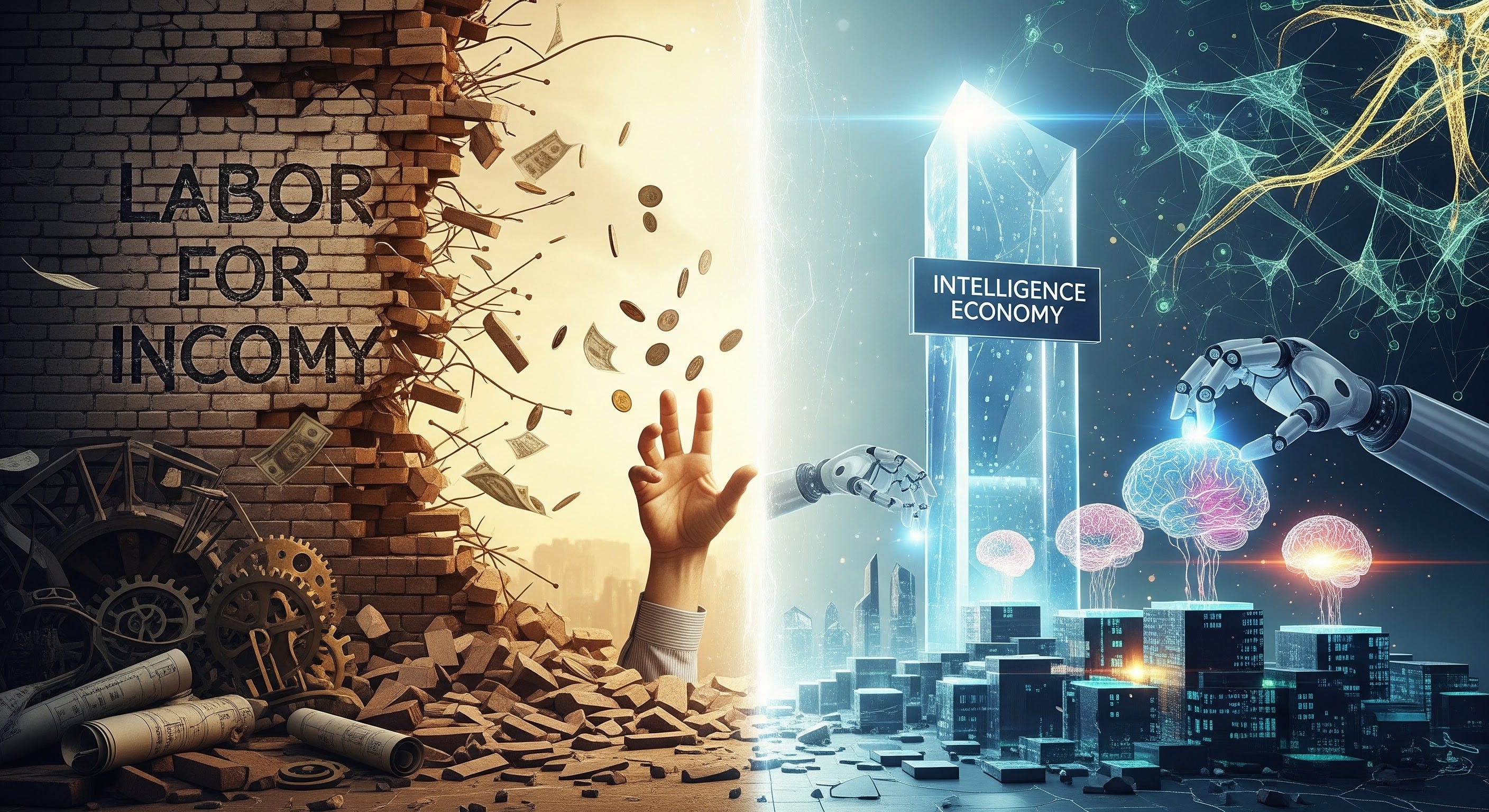
Not struggle to find jobs. Not need different jobs. Not need jobs at all.
AI will perform 80% of all work. Labour costs approach zero. A billion bipedal robots arrive within a decade. And $10,000 will buy more than $100,000 buys today. “The need to work will go away,” Khosla told Fortune. “People will still work on the things they want to work on, not because they need to work.”
Most commentary treated this as either inspiring or alarming. I think it is something more important. It is the first mainstream articulation of what I have been calling the intelligence economy: the end of the 300-year economic model in which humans exchange labour for income.
Khosla is describing the death of the system that has governed every modern economy since the Industrial Revolution. And he is describing it casually, as if the replacement infrastructure already exists.
It does not. Building it is the central challenge of the next fifteen years. And almost nobody is working on it.
The model that is ending
For three centuries, the dominant economic bargain has been simple: humans provide labour, employers provide income, income purchases goods and services, and the cycle sustains itself. Governments tax this cycle to fund public services. Banks lend against future earnings. Entire social systems — education, healthcare, pensions, housing — are built on the assumption that most adults will exchange productive work for money for most of their lives.
This model survived the steam engine, electrification, the assembly line, the computer, and the internet. Each technology disrupted specific jobs but created new categories of work that absorbed displaced workers. Agricultural workers became factory workers. Factory workers became service workers. Service workers became knowledge workers. The cycle always renewed itself because previous technologies automated tasks, not capabilities. They made specific activities cheaper while leaving the general capacity for human judgment, creativity, and coordination as the scarce input that commanded a wage premium.
AI breaks this pattern. Not because it automates a task. Because it automates the capability itself. When Khosla says AI will replace physicians, accountants, radiologists, and salespeople, he is not describing a tool that helps these professionals work faster. He is describing a system that performs their cognitive function. The general capacity for human judgment that has been the scarce input for all of modern economics is becoming abundant.
Anthropic CEO Dario Amodei described this as AI being a “general labour substitute for humans.” Not a tool. A substitute. That distinction is the difference between every previous technology and this one. And it is the reason the labour-for-income model breaks.
When the scarce input becomes abundant, its market price approaches zero. That is not a prediction. That is supply and demand.
Consider what this means concretely. A junior financial analyst earns $80,000 per year because her judgment about financial models has scarcity value. When an AI produces equivalent analysis at near-zero marginal cost, her scarcity premium evaporates. Not because she became less capable. Because the market no longer needs to pay for capability when it can access it for the price of a software subscription. This repricing is already happening in legal research, in copywriting, in software development, and in financial analysis. It will move through every profession where the core value proposition is “I will apply cognitive skill to your problem.”
Elon Musk, who shares Khosla’s vision, imagines specialised robots outnumbering human physicians and a universal high income supporting a population that no longer needs to work. Microsoft AI CEO Mustafa Suleyman says virtually all office tasks will be automated within eighteen months. Jack Dorsey, after cutting 40% of Block’s workforce, predicted most companies will make similar structural changes within a year.
These are not fringe voices. These are the people building, funding, and deploying the systems. When they converge on the same message — that human labour is being structurally replaced, not just augmented — that convergence is itself a data point worth taking seriously.
What $15 trillion going away actually means
Khosla said $15 trillion of U.S. GDP will “mostly go away.” He framed this as almost incidental. GDP becomes less meaningful. Prices fall. Less income is needed.
I want to map what that sentence actually contains.
$15 trillion is not just a number. It is wages paid. It is consumer spending, which constitutes roughly 70% of U.S. GDP. It is the tax base that funds Social Security, Medicare, Medicaid, defence, infrastructure, education, and every federal, state, and local programme. It is the income against which mortgages are underwritten, student loans are issued, and retirement plans are structured.
When Khosla says that $15 trillion goes away, he is describing the simultaneous unwinding of the consumer economy, the public finances, and the social safety net. He is describing the end of the fiscal model that funds modern government. He is describing the evaporation of the income base against which $13 trillion in residential mortgages, $1.7 trillion in student loans, and $4.8 trillion in consumer debt are held.
This is not a transition. It is a phase change. And unlike a transition, which implies continuity between the old system and the new one, a phase change means the new state operates on fundamentally different principles.
Khosla is right that the new state could be one of abundance. If AI drives production costs toward zero, goods and services become radically cheaper. Material scarcity may genuinely end for basic needs. That is an extraordinary possibility.
But phase changes have a property that utopian narratives ignore: the transition between states is where the energy is released. When water becomes steam, the phase change is violent. When an economy shifts from labour-based to intelligence-based, the phase change is equally violent — for the people and institutions caught in it.
The Citrini Research scenario that went viral in February, triggering actual stock selloffs and a rebuttal from Citadel Securities, described one version of this phase change: a negative feedback loop where companies lay off workers, use the savings to buy more AI capability, displaced workers spend less, companies facing lower demand invest more in AI to protect margins, and the cycle accelerates. Citrini called it “Ghost GDP” — economic output that shows up in national accounts but never circulates through the human economy because machines produce but machines do not consume.
Whether Citrini’s specific timeline was right is beside the point. The mechanism they identified is real. And the phase change between the old economy and the new one is where that mechanism does its damage. Not in 2040, when abundance may have arrived. In the years between now and then, when the old system is dying and the new one has not been built.
The market is already pricing the transition
The early evidence is visible. On February 27, Block CEO Jack Dorsey cut 40% of his workforce — 4,000 people — explicitly because AI made them unnecessary. The business was strong. Revenue growing. He simply needed fewer humans.
Block’s stock surged 20% the next day. The market celebrated.
That 20% surge is the most important economic signal of 2026 so far. It tells every CEO and every board of directors that shareholders will reward the elimination of human labour. Not gradually. Not reluctantly. Enthusiastically. Dorsey predicted that within a year, the majority of companies will make similar structural changes. “I’d rather get there honestly and on our own terms than be forced into it reactively.”
Goldman Sachs noted the cuts targeted engineering roles. Block is now targeting north of $2 million in gross profit per employee, quadruple pre-COVID levels. Autodesk’s CEO confirmed the same calculus: “We are going to hire less people because of efficiency.”
Meanwhile, IBM is tripling entry-level hiring for 2026. Its chief human resources officer, Nickle LaMoreaux, warned that companies eliminating junior roles today will face catastrophic talent shortages within five years. IBM rewrote job descriptions to shift entry-level work away from automatable tasks toward customer engagement and AI oversight. LaMoreaux understands what Khosla’s framing misses: if you eliminate the human pipeline for fifteen years while waiting for abundance to arrive, you do not have humans capable of directing AI when it gets there.
The market is rewarding Block. It is ignoring IBM’s warning. That asymmetry will define the transition.
The three structural problems of the intelligence economy
If the labour-for-income model is ending, three structural problems must be solved for any replacement to work. Nobody has solved any of them.
The demand problem. When AI produces goods and services but the humans who used to earn wages producing them no longer have income, who buys the output? Machines produce but machines do not consume. This is what Citrini Research called “Ghost GDP” in their viral scenario: output that inflates national accounts but never circulates through the human consumer economy. Khosla says prices will fall, requiring less income. But wages disappear immediately while prices adjust gradually. The transition between the old equilibrium and the new one is where demand collapses.
The ownership problem. When Khosla says labour becomes free, what he means is that returns to labour approach zero while returns to AI capital approach infinity. The people who own the compute, the models, and the data capture all the value. Everyone else becomes dependent. Every previous technological revolution concentrated wealth among the owners of the new means of production. The intelligence revolution concentrates it further because the means of production, intelligence itself, has no natural limit. A factory has finite output. An AI model can be replicated at near-zero marginal cost. The ownership concentration this produces is unlike anything in economic history.
The funding problem. Modern government is funded by taxing the labour-for-income cycle: income tax, payroll tax, corporate tax on labour-generated profits, sales tax on consumer spending funded by wages. When that cycle breaks, the fiscal model breaks with it. How do you fund public education when the tax base that supports it has evaporated? How do you fund healthcare, pensions, infrastructure? Khosla’s $10,000 buying more than $100,000 does today assumes that public services continue to exist. But those services are funded by the very economic activity that AI is displacing.
This is the question I find most urgent and least discussed. The utopians assume that abundance will fund itself. But abundance produced by AI accrues to AI owners as profit. Converting that profit into public services requires a political decision to tax it and a governance mechanism to distribute it. Neither exists at the scale required. And the current political trajectory in the United States, where the administration is actively reducing government capacity and deregulating technology companies, is moving in the opposite direction.
Countries with sovereign wealth, like Singapore with its combined GIC and Temasek reserves exceeding $1.4 trillion, have a buffer. Most countries do not. The fiscal transition from labour-taxed government to AI-taxed government is a redesign of the social contract as fundamental as anything since the creation of the welfare state. Nobody has a credible plan for it.
What replaces the old model
I have been developing frameworks for what comes next. None of them are complete. All of them are necessary to start thinking about now.
The Human Prosperity Index. If GDP becomes meaningless, as Khosla suggests, what do we optimise for? I propose measuring Material Abundance, Capability Access, Agency Preservation, Sustainability Balance, and Social Cohesion. These five dimensions capture what actually matters to human wellbeing in an economy where production is automated but distribution is not.
Universal Basic Intelligence. Rather than Universal Basic Income, which provides subsistence, I propose Universal Basic Intelligence: guaranteed access to AI capabilities that enable human potential amplification. The difference matters. UBI keeps people alive. UBInt keeps people capable. In an intelligence economy, access to AI determines what you can do and become. Making that access universal is the equivalent of making literacy universal in the industrial economy — not charity, but infrastructure.
The ownership restructuring. If AI capital captures all returns, then the distribution of AI capital ownership becomes the defining economic question. Models include Universal Basic Capital, where every person owns a share of AI infrastructure from birth. They include AI productivity dividends, where AI-generated profits are taxed and distributed. They include public ownership of foundational models, where the base layer of intelligence is treated as a public utility rather than a private asset.
None of these are politically easy. All of them are structurally necessary.
Singapore, which I examined in Week 14 as the most AI-forward government on Earth, is approaching this challenge through workforce training — 100,000 workers made AI bilingual by 2029. That is a jobs-based solution to what is becoming an ownership problem. Training people to use AI tools is valuable, but it does not address who owns the AI generating the economic value, who captures the productivity gains, or how the gains are distributed when the labour-for-income pipeline that normally distributes them no longer functions.
The intelligence economy requires new distribution mechanisms. Not because we choose redistribution as a political preference. Because the old distribution mechanism — wages paid for work performed — is being structurally dismantled. Without a replacement, the economy produces abundance that concentrates in the hands of compute owners while the consuming population that sustains demand loses its purchasing power. That is not a recession. It is a systemic failure of the circular flow that makes market economies function.
The fifteen-year window
Khosla’s vision of 2040, where work is optional and abundance is universal, may be directionally correct. But between here and there lie fifteen years in which the old economic model is dying and the new one has not yet been built.
During those fifteen years, markets will reward the destruction of human employment. Block’s 20% stock surge proved it. Dorsey says most companies will follow within a year. The incentive structure is pointing in exactly one direction: replace humans as fast as possible.
During those same fifteen years, the institutions that would normally manage a transition of this scale — governments, central banks, international organisations — will be operating on clocks that the technology has already outpaced, as I documented in Week 14. The three speeds problem does not go away because the destination is beautiful.
And during those fifteen years, the people displaced from the old model will need to eat, pay rent, raise children, and maintain dignity. They cannot wait for the ownership models, the tax frameworks, and the distribution systems that should have been designed years ago.
The Forrester data tells us what the transition looks like in practice. Companies that laid off workers for AI are quietly rehiring, often offshore, at lower wages. Klarna replaced 700 customer service workers with AI, saw quality decline, and began rehiring humans at reduced wages. 55% of employers who made AI-driven cuts now regret them. But each cycle, even the failed ones, reprices human work downward. Each cycle degrades institutional knowledge. And each cycle widens the gap between where we are and where the utopians say we are going.
The intelligence economy will not arrive as a single event. It will arrive as a series of repricing waves, each one reducing the market value of another category of human cognitive work. Legal research. Financial analysis. Software development. Medical diagnosis. Content creation. Strategic consulting. Each wave will be celebrated by shareholders and mourned by the displaced. And the cumulative effect will be the gradual, then sudden, unwinding of the economic model that has structured human civilisation for three centuries.
This is what I mean by framing the intelligence economy. Not predicting it. Not fearing it. Mapping its structural logic so that we can build the institutions, the ownership models, the distribution systems, and the social contracts that the new economy requires. That work should have started five years ago. It is not too late. But the window is closing faster than most people understand.
Khosla ended his interview by saying “AI will free us to be more human.” I want that to be true. I am working toward a future where it is true. But Block’s 4,000 laid-off workers were not freed. They were repriced to zero. And the market celebrated.
The intelligence economy is coming. The question is not whether it arrives. It is whether we build it for everyone or allow it to be built for the few.
That is what the next fifteen years will decide. And the clock started before most people noticed.
Dr. Elias Kairos Chen is the author of “Framing the Intelligence Revolution: How AI Is Already Transforming Your Life, Work, and World” and a strategic advisor on AI transformation across 20+ countries.
Next week: Three Models for the Post-Work Economy — what replaces employment when intelligence is free.