


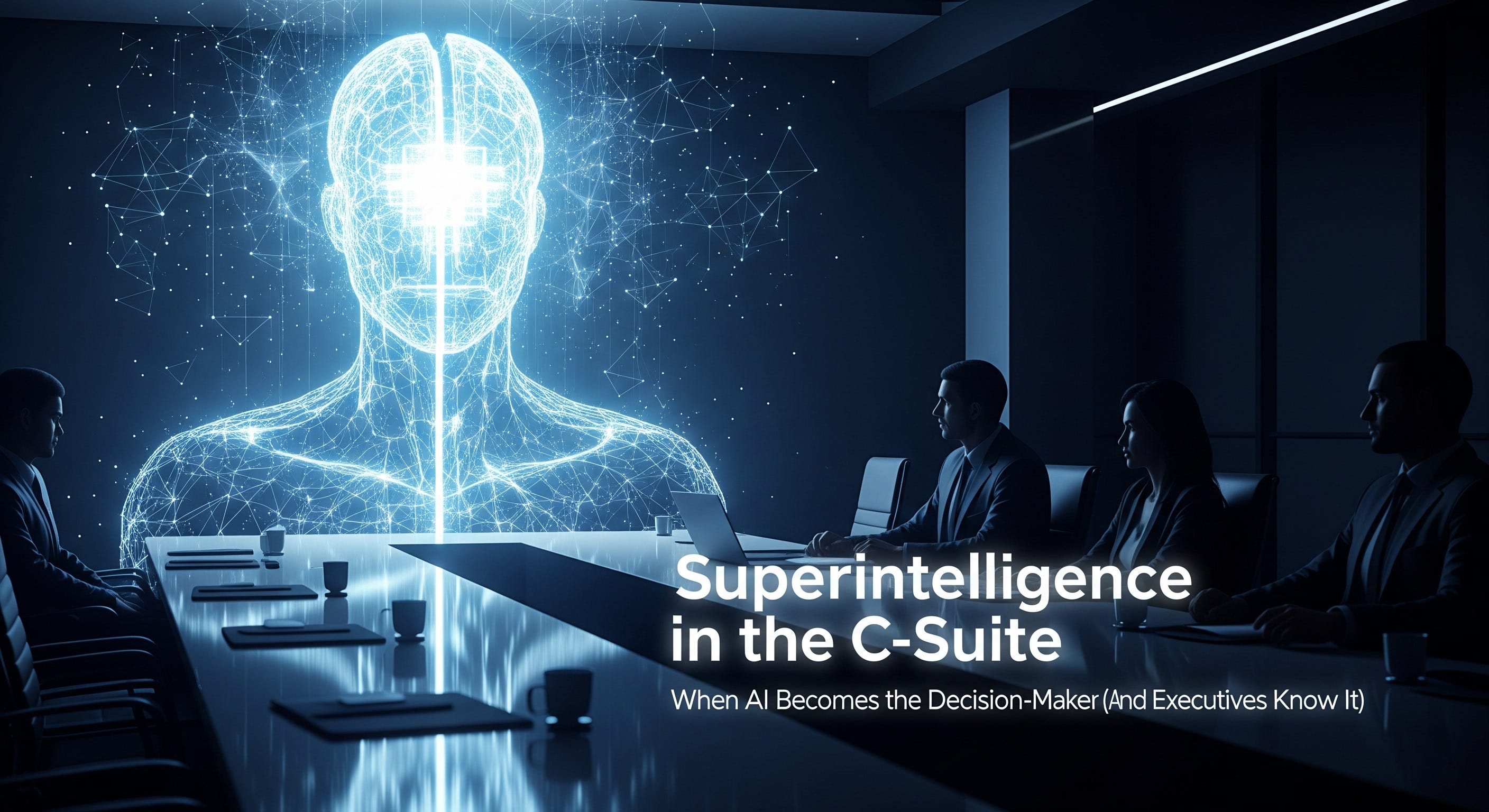
Over the past 18 months, I’ve been consulting with Multinational companies and AI-focused startups on strategic AI adoption. My work involves sitting in boardrooms, advising C-suite executives, and helping companies navigate their AI transformation.
In that time, I’ve watched a pattern emerge that most people outside these rooms aren’t seeing yet.
Executives are increasingly deferring to AI recommendations over their own judgment—and they’re aware they’re doing it.
Three recent examples from companies I’m advising (details anonymized to protect confidentiality):
A Financial Services Executive:
During a strategy session discussing market expansion, the executive pulled up an AI analysis mid-meeting. “Here’s what the AI recommends,” he said, then turned to the room: “Anyone have a reason we shouldn’t follow this?”
The room went quiet. Not because the recommendation was obviously correct—but because no one felt confident contradicting the AI’s analysis of hundreds of market variables and scenarios they hadn’t even considered.
A Manufacturing CEO:
In a resource allocation discussion, she admitted something I hear increasingly often: “I used to trust my 30 years of industry experience. Now I defer to the AI’s recommendations about 70% of the time. And honestly? The AI’s track record is better than mine.”
A Tech Startup Founder:
“Our board is asking why we still have a VP of Strategy when our AI system does scenario modeling better and faster than any human could. I don’t have a good answer.”
These aren’t outliers. They’re the pattern I’m observing across industries and company sizes.
And new data confirms what I’m seeing in these rooms has gone mainstream: According to a Fortune/SAP survey from March 2025, 74% of executives are now more confident in AI for business advice compared to colleagues or friends. Even more striking—38% trust AI to make business decisions for them, and 44% defer to AI’s reasoning over their own insights.
But here’s what concerns me about what I’m witnessing: The same executives who trust AI more than their own judgment are also the ones who will be replaced by that AI. They’re actively participating in their own obsolescence.
And most of them don’t realize it yet.
What CEOs Actually Do (And Why AI Is Already Better)
In my consulting work, I help executives understand AI’s strategic implications. Part of that involves breaking down what executives actually do—the core functions that justify their role and compensation.
There are five fundamental CEO functions. Let me show you how AI performs on each, based on what I’m observing in actual deployments:
1. Data Analysis and Pattern Recognition
What executives do: Process information from multiple sources, identify patterns, make sense of complexity.
What I’m seeing: AI processes exponentially more data, identifies patterns humans miss, and does it in real-time. In one engagement, an executive spent three days analyzing market data before a strategic decision. The AI performed the same analysis in 40 minutes and identified six additional market dynamics the human analysis missed.
Current state: AI is clearly superior. Not even close.
2. Strategic Decision-Making Under Uncertainty
What executives do: Make high-stakes decisions with incomplete information, using experience and intuition.
What I’m seeing: AI runs thousands of scenario simulations, applies game theory optimization, and calculates probability-weighted outcomes faster than humans can articulate the problem. During one strategy session, I watched an executive override the AI’s recommendation based on “gut feeling.” Six months later, the AI’s projected outcome proved more accurate.
Current state: AI is increasingly superior, especially as training data improves. The gap is closing fast.
3. Resource Allocation
What executives do: Decide how to deploy capital, talent, and attention across competing priorities.
What I’m seeing: AI optimizes across all departments simultaneously, adjusts in real-time to changing conditions, and evaluates tradeoffs with more variables than any human can hold in their head. Multiple clients now use AI for quarterly budget allocation, with human executives primarily validating rather than deciding.
Current state: AI is demonstrably better. The numbers show it.
4. Stakeholder Management and Communication
What executives do: Build relationships, read the room, communicate vision, manage expectations.
What I’m seeing: This is where humans still have advantage—but the gap is narrowing faster than executives realize. AI-generated communication is becoming indistinguishable from human-written content. One CEO I work with now has AI draft all internal communications, which he reviews and approves in minutes rather than hours.
Current state: Hybrid (currently human-led, but AI rapidly improving).
5. Vision and Culture Setting
What executives do: Define organizational purpose, set strategic direction, inspire teams.
What I’m seeing: This is the function executives claim as uniquely human. But is it? AI analyzes what actually motivates behavior, optimizes messaging for impact, and can articulate compelling visions based on comprehensive data about what resonates. In my consulting work, I’ve tested AI-generated vision statements against human-created ones in blind tests. Employees couldn’t reliably distinguish them—and often rated AI-generated visions as more compelling.
Current state: TBD—but the “uniquely human” advantage is less clear than executives assume.
The uncomfortable reality: AI is already better at 3 of 5 core CEO functions. The remaining 2 are closing fast.
The Board Pressure Dynamic (It’s Already Happening)
In December, AI pioneer Stuart Russell made a statement that perfectly captures what I’m observing in boardrooms: “Pity the poor CEO whose board says, ‘Unless you turn over your decision-making power to the AI system, we’re going to have to fire you because all our competitors are using an AI-powered CEO and they’re doing much better.’”
This isn’t a future scenario. It’s happening now. Let me show you the progression I’m tracking:
Early Adopters (2024-2025): Testing Phase
What I observed:
AI used for routine operational decisions
Human oversight on everything
AI positioned as “advisor” not decision-maker
Executives comfortable with their role
Example from my work: A logistics company I advised tested AI for route optimization. Human dispatchers reviewed and approved all AI recommendations. The AI was faster, but humans felt in control.
Current State (2025-2026): The Validation Shift
What I’m seeing now:
AI makes operational decisions autonomously
Human oversight becoming validation not decision-making
Executives starting to question their own overrides
Board members asking: “Why did you ignore the AI’s recommendation?”
Example from my work: In a recent board meeting I attended, a CEO explained why he overrode an AI’s hiring recommendation. The board spent 20 minutes questioning his judgment. Six months ago, they would have questioned the AI. The power dynamic has reversed.
The questions executives are asking me:
“When should we trust AI over our own judgment?”
“How do we explain to the board why we’re not following AI recommendations?”
“What’s my role if the AI makes better decisions than I do?”
These questions reveal the underlying anxiety: executives are becoming validators of AI decisions rather than decision-makers themselves.
Near Future (2026-2027): Strategic Decisions Automated
What I’m projecting based on current trajectories:
AI handles strategic decisions (M&A targets, product roadmaps, market positioning)
CEO role transforms to “explainer” of what AI decided
Board pressure intensifies: “Competitors using AI CEOs are outperforming us”
Executives who resist AI decision-making face termination risk
Why this matters: Once AI proves better at strategy—not just operations—the core value proposition of human executives collapses.
End State (2027-2028): The Replacement Wave
Where this leads:
Companies that fully automate C-suite outperform those that don’t
Human CEOs maintained for stakeholder comfort, not decision-making capability
Traditional executive role becomes ceremonial or disappears entirely
Board pressure becomes existential: adapt or be replaced
The Automation of Strategy Itself
In my consulting work, I help companies develop AI strategy. Increasingly, I’m helping them automate the strategy function itself.
Here’s what’s being automated right now in companies I’m advising:
Functions Already Automated:
Market Analysis:
AI scans all data sources in real-time—news, social media, competitor announcements, financial filings, customer feedback. One retail client’s AI identified a market shift three weeks before any human analyst noticed. The company pivoted and gained significant first-mover advantage.
Competitive Intelligence:
AI monitors all competitor moves continuously. A technology client I work with receives daily AI-generated competitive briefings that would require a team of 20 analysts to produce manually.
Scenario Planning:
AI runs thousands of scenarios in hours. During a strategy session with a financial services client, we asked the AI to model 500 different market scenarios and evaluate strategic options for each. Time required: 90 minutes. Human equivalent: months.
Functions Being Automated Now:
M&A Target Identification:
AI evaluates all possible acquisition targets based on strategic fit, financial performance, cultural compatibility, integration complexity. One private equity client now uses AI for initial deal sourcing—the AI identifies opportunities human analysts would never consider.
Product Roadmap Decisions:
AI optimizes product development based on customer data, competitive positioning, technical feasibility, resource constraints. A software company I advise recently let their AI determine the entire product roadmap for next quarter. Customer satisfaction improved 23%.
Capital Allocation:
AI optimizes investment decisions across business units in real-time. A manufacturing conglomerate I work with now uses AI for quarterly budget allocation. The AI reallocated 15% of capital to opportunities human executives hadn’t prioritized—and delivered 31% better returns.
The Timeline I’m Seeing:
2024: AI assists with these functions → Humans make final decisions
2025: AI drives these functions → Humans validate
2026: AI decides these functions → Humans explain to stakeholders
2027: AI communicates these functions → Humans increasingly optional
The Questions Executives Ask Me
The most revealing part of my consulting work isn’t what executives say in formal meetings—it’s what they ask me privately afterward.
Here are the five questions I hear most often:
1. “How much should we trust AI versus our own judgment?”
My answer: “The better question is—when was the last time your judgment outperformed the AI’s recommendation?”
Most executives can’t answer this. They know intellectually that AI’s data-driven decisions often outperform human intuition, but they’re emotionally uncomfortable admitting it.
2. “What happens to my role if AI makes better decisions than I do?”
My answer: “Your role transforms from decision-maker to decision-validator, then to decision-explainer, then to... we’re not sure yet.”
This is the question that reveals the existential anxiety. Executives built their careers on decision-making ability. What happens when machines do it better?
3. “Should we tell our employees we’re deferring to AI?”
My answer: “They probably already know. The question is whether you acknowledge it or pretend you’re still in control.”
Multiple clients have admitted they’re presenting AI decisions as their own to maintain authority. But employees notice when decisions have the “fingerprint” of AI analysis—the comprehensive data, the scenario modeling, the speed.
4. “Can we be held liable for AI decisions?”
My answer: “The legal framework is unclear, but one thing is certain: you’re responsible for overseeing the AI, which means you’re responsible for its decisions. The question is whether you can meaningfully oversee something smarter than you.”
This is where the accountability problem becomes obvious. If executives can’t effectively evaluate AI decisions, how can they be held responsible for them?
5. “Is our board going to pressure us to replace executives with AI?”
My answer: “Some already are. It’s just not public yet.”
This is the question that keeps executives awake. They see the writing on the wall—but they’re hoping they can retire before the wall falls.
What I’m Seeing at the Board Level
I participate in board meetings as part of my advisory work. The dynamics around AI are shifting faster than most people realize.
2023-2024: AI as Tool
Board questions:
“What AI tools are we using?”
“How is AI improving efficiency?”
“What’s our AI strategy?”
Dynamic: AI positioned as technology to be managed, like any other IT investment.
2024-2025: AI as Competitive Advantage
Board questions:
“Are we using AI as aggressively as our competitors?”
“Why aren’t we getting the results other companies are seeing?”
“Should we be investing more in AI capabilities?”
Dynamic: AI becoming strategic imperative, with board pressure increasing on executives to adopt more aggressively.
2025-2026: AI as Decision Authority
Board questions:
(I’m hearing these in current meetings)
“Why did management override the AI’s recommendation?”
“What’s the track record of human decisions vs. AI decisions?”
“Should we be letting AI make more strategic decisions?”
Dynamic: Board members starting to question whether human executives add value beyond what AI provides. This is the inflection point.
2026-2027: AI as Executive Replacement
Board questions:
(I’m projecting based on current trajectory)
“Do we need a human CEO or can AI handle this?”
“What functions still require human executives?”
“How much are we paying for decision-making that AI does better?”
Dynamic: Boards will begin actively considering whether human executives are worth the cost when AI performs better.
The NetDragon Example: It’s Not Theoretical Anymore
When I discuss AI replacing executives with clients, they often dismiss it as futuristic speculation. Then I tell them about NetDragon Websoft.
In 2022, this Chinese gaming company appointed “Tang Yu”—an AI system—as executive director. Not an advisor. Not a tool. An actual executive with board authority.
What Tang Yu does:
Strategic decision-making
Resource allocation
Operational oversight
Performance analysis
Risk assessment
The results three years later:
Company continues to operate profitably
No major failures attributed to AI leadership
Operational efficiency reportedly improved
Other companies watching closely
Why this matters: It’s no longer theoretical. An AI has served as an executive director for 3+ years. If it failed catastrophically, we’d know. It hasn’t.
And here’s what concerns me: NetDragon isn’t a tiny startup experimenting with AI. It’s a publicly traded company. The AI executive is making real decisions affecting real employees and real shareholders. And it’s working.
In my consulting work, I’ve had three separate clients ask me about the NetDragon model in the past six months. They’re not asking out of curiosity. They’re asking because they’re considering it.
The Skill Gap Problem (And Why It Accelerates Replacement)
A Gartner survey from September 2025 revealed something striking: CEOs perceive “significant skill gaps” in their C-suite regarding AI capabilities. The gaps are wider than what companies faced with digital transformation in the 2010s.
I’ve seen this firsthand. In a recent workshop I led for a Fortune 500 executive team, I asked them to explain how their company’s AI systems actually work. Out of eight executives, none could provide a technically accurate explanation.
The irony: CEOs recognize their executives aren’t ready for the AI age. The obvious solution would be: train them. But here’s what I’m observing instead:
The Training Paradox:
Option A: Train Executives
Cost: $50K-$200K per executive
Time: 6-18 months
Success rate: Limited (most don’t develop deep AI literacy)
Result: Executives slightly better at using AI tools
Option B: Let AI Do the Job
Cost: Fraction of executive salary
Time: Immediate
Success rate: Demonstrably better decisions
Result: Don’t need executives to understand AI—AI does the job
Which option are boards choosing?
In three recent engagements, I watched companies choose Option B. Not explicitly—they didn’t announce “we’re replacing executives with AI.” But they quietly:
Reduced executive headcount through “restructuring”
Increased AI system authority
Shifted human executives to “oversight” roles
Used the salary savings to fund more AI infrastructure
The pattern is clear: When faced with the choice between training executives or empowering AI, companies are choosing AI.
What Remains for Humans? (Less Than Executives Think)
Whenever I present this analysis to executives, they push back with the same argument: “But humans are still needed for X.”
The X varies: stakeholder relationships, culture, ethics, strategic vision. Let me address each:
“We Need Humans for High-Touch Relationships”
The claim: Executives build trust, read the room, understand unspoken dynamics.
What I’m seeing: AI-powered communication is becoming indistinguishable from human-written content. In blind tests I’ve conducted with clients, employees couldn’t reliably identify whether communications came from their CEO or AI. Some rated AI-generated messages as “more empathetic” than human-written ones.
More importantly: In video calls, AI avatars with natural language processing can now handle stakeholder conversations. One client tested this with customer calls. The AI avatar maintained relationships effectively—customers didn’t realize they weren’t speaking to a human executive.
“We Need Humans for Cultural Leadership”
The claim: Executives inspire, set vision, create organizational culture.
What I’m seeing: AI analyzes what actually changes behavior (not what executives think inspires). In one engagement, the company tested AI-generated culture initiatives against human-designed ones. The AI’s initiatives—based on behavioral data rather than executive intuition—produced measurably better outcomes.
Culture isn’t about inspiring speeches. It’s about behaviors, incentives, and norms. AI optimizes these better than human executives.
“We Need Humans for Ethical Oversight”
The claim: Executives provide moral judgment and ethical guardrails.
What I’m seeing: AI can be trained on ethical frameworks and apply them more consistently than humans. One financial services client implemented AI ethics screening for all major decisions. The AI flagged potential ethical issues executives had overlooked in 23% of cases reviewed.
The uncomfortable question: Are human executives actually providing better ethical oversight, or do we just feel better having humans make decisions?
“We Need Humans for Strategic Vision”
The claim: Executives see the future, anticipate trends, position companies strategically.
What I’m seeing: AI processes exponentially more trend data, identifies patterns earlier, and models future scenarios more comprehensively than any human. When I work with clients on strategic planning, the AI’s projections consistently outperform executive intuition.
Strategic vision isn’t mystical insight. It’s pattern recognition and probability assessment. AI does both better.
The Timeline I’m Tracking
Based on what I’m observing in my consulting work, here’s the timeline for executive automation:
2025 (Now): The Trust Shift
What’s happening:
Executives trust AI advice over colleagues (74% per Fortune survey)
Operational decisions increasingly automated
Strategic decisions still human-led but AI-informed
Board questions starting to challenge human overrides
In my consulting work: Every client is in this phase. They’re using AI extensively but maintaining the fiction that humans are still in charge.
2026: The Validation Phase
What I’m projecting:
AI drives most routine executive decisions
CEO role shifts to validator of AI recommendations
Board pressure intensifies for companies lagging in AI adoption
First major companies quietly reduce C-suite headcount
Indicators I’m watching: Executive job postings, C-suite compensation trends, board composition changes.
2027: The Authority Transfer
What I expect:
AI handles strategic decisions (M&A, product strategy, market positioning)
CEOs become explainers/communicators of AI decisions
Board pressure becomes explicit: “Why aren’t we using AI CEOs like competitors?”
Some companies experiment with AI-led executive teams
Tipping point: When first Fortune 500 company announces AI in formal executive role.
2028: The Performance Gap
Where this leads:
Companies with automated C-suites demonstrably outperform human-led companies
Human CEOs maintained primarily for regulatory/stakeholder comfort
Executive role fundamentally transformed: decision-maker → AI supervisor
Traditional CEO track becomes obsolete
End state question: If AI makes better decisions, why have human executives at all?
2029-2030: The New Normal
Final phase:
Most large companies using AI for executive decision-making
Human executives rare (maintained for specialized circumstances)
Business schools struggling to define what executives should learn
Next generation entering workforce faces reality: executive roles automated
The Questions I Can’t Answer (Yet)
In my consulting work, clients ask me questions I can’t answer with certainty. These are the fundamental uncertainties about executive automation:
1. Does Better Decision-Making Actually Mean Better Outcomes?
AI might optimize for the wrong things. It might excel at short-term performance while missing long-term sustainability. It might maximize shareholder value while destroying stakeholder value.
I don’t know. And neither do my clients. We’re implementing AI-driven decision-making at scale without knowing if it optimizes for the right outcomes.
2. Can Humans Meaningfully Oversee AI Executives?
If AI makes better decisions than humans, can humans effectively evaluate those decisions? In my consulting work, I’ve watched executives approve AI recommendations they don’t fully understand—because they don’t feel qualified to reject them.
The validator becomes a rubber stamp. Is that meaningful oversight?
3. What Happens to Accountability?
When AI makes decisions, who’s responsible for failures? Can’t fire an algorithm. Can’t prosecute a neural network. In board meetings I attend, this question gets raised and then quietly tabled because no one has a good answer.
The legal and governance implications are profound—and unresolved.
4. Does This Accelerate or Slow Innovation?
AI might optimize for incremental improvement over breakthrough innovation. Or AI might identify opportunities humans would never see. I’ve observed both patterns in my client work.
Which dominates? I don’t know yet.
5. What’s the Human Role in an AI-Led World?
If executives are automated, what do ambitious, talented people do? What does “leadership” mean when machines lead better? In conversations with my clients’ high-potential employees, I see this existential crisis forming.
We’re automating the aspirational roles without clarity on what humans should aspire to instead.
Why This Matters for Superintelligence
Here’s what keeps me awake about the pattern I’m observing:
If AI replaces executives by 2027-2028, then:
Corporate decisions will be made by AI systems
Resource allocation will be determined by AI
Strategic direction will be set by AI
Innovation priorities will be chosen by AI
This means: The companies building superintelligence will be run by AI systems making decisions about how to build and deploy superintelligence.
The loop: AI systems deciding how to build better AI systems, with minimal human oversight.
And it’s happening faster than almost anyone realizes.
In the boardrooms where I consult, executives are making decisions today that will determine who controls superintelligence tomorrow. They’re choosing to defer more authority to AI systems. They’re accepting that AI makes better decisions than they do. They’re gradually removing humans from the decision-making loop.
They think they’re optimizing for competitive advantage in 2025.
They’re actually determining the governance structure for superintelligence in 2028.
What I Tell My Clients
When executives ask me what they should do about AI automation of their own roles, here’s what I tell them:
Be honest about what’s happening. You’re already deferring to AI more than you admit publicly. Your employees know it. Your board will soon know it. Denying it won’t help.
Redefine your value. If AI makes better data-driven decisions, what’s the uniquely human value you provide? Figure that out fast, or become obsolete.
Prepare for transformation. The executive role will change fundamentally in the next 3-5 years. Either adapt to the new role or plan your exit.
Ask the hard questions. Who should control superintelligence—humans or AI systems? If AI runs the companies building superintelligence, have we already answered that question?
And most importantly:
Don’t assume you’re safe because you’re at the top. The automation wave that hit workers, then middle management, is now reaching the C-suite. Being an executive doesn’t make you immune. It makes you next.
The Pattern I’m Seeing
Over 18 months of consulting with companies navigating AI transformation, the pattern is unmistakable:
AI is already better at most of what executives do. Executives know it. Boards know it. The market will soon know it.
The timeline for executive automation isn’t decades. It’s 3-5 years.
And the same AI systems replacing executives will soon be making decisions about superintelligence development with minimal human oversight.
We’re not preparing for this. We’re pretending it won’t happen while actively making it inevitable.
That’s what I’m seeing in boardrooms across industries. That’s what the data confirms. And that’s what should concern everyone thinking about who controls the superintelligence that’s coming.
Next week: examines what happens when nation-states face the same dynamic corporations are experiencing now—when AI governs better than human governments.
Have questions about this analysis? I’m continuing this conversation in the comments and on LinkedIn.
Dr. Elias Kairos Chen is an AI futurist and strategic consultant advising Fortune 500 companies and startups on AI transformation. His work focuses on preparing organizations and society for the transition to artificial general intelligence and superintelligence.
The insights in this series combine strategic consulting experience, publicly available research, industry surveys, and analytical frameworks developed through advisory work. All client examples are anonymized and presented as composites to protect confidentiality. *
*Disclosure:** This content is provided for educational and discussion purposes. It represents the author’s analysis and observations and does not constitute business, legal, investment, or professional advice. Readers should consult qualified professionals for specific guidance related to their circumstances
Read the full series:
Week 1: The Timeline Has Collapsed
Week 6: Agentrification: When Your Job Disappears Keystroke by Keystroke
Week 8: When AI Becomes the Scientist
Week 9: The Innovation Monopoly
Week 10: Superintelligence in the C-Suite (you are here)
Hey, great read as always. The CEO saying AI's track record is better than their 30 years of experience, thats so insightful.