


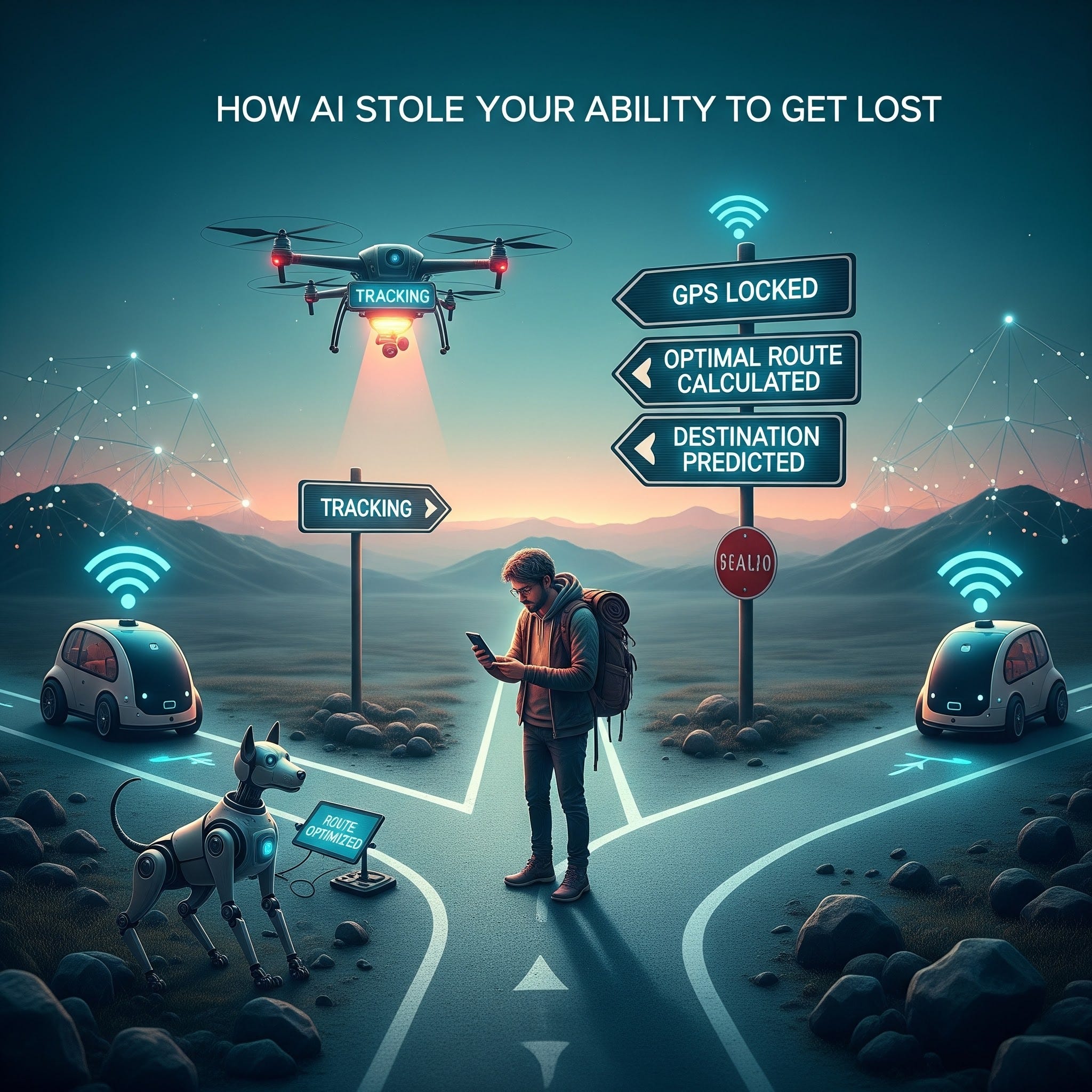
“We’ve created a generation that will never know the educational value of being lost, the creative potential of boredom, or the growth that comes from solving problems without algorithmic assistance.” — Nicholas Carr, author of The Shallows
The Day the Maps Went Dark
On a Tuesday morning that started like any other, Google Maps experienced a global outage lasting four hours and seventeen minutes. What happened during those 257 minutes revealed how completely we’ve surrendered our navigational autonomy to artificial intelligence.
Emergency services reported massive spikes in “directional assistance” calls. Police departments logged thousands of calls from drivers who couldn’t navigate familiar routes without turn-by-turn guidance. Uber and Lyft suspended operations in major cities after drivers couldn’t function without navigation assistance. Perhaps most telling: professionals who had worked in the same buildings for years found themselves unable to navigate without their phones directing them.
A teacher’s observation during the outage went viral on social media: “My high school students are in the building across the street for PE. They can SEE it from our window. Without Google Maps, half of them just stood in the parking lot, literally unable to figure out how to walk 100 yards to a visible building. This is what we’ve done to their brains.”
The incident passed, Maps came back online, and life returned to normal. But for those hours, humanity glimpsed its future: a species that had traded the ability to navigate physical and mental spaces for the convenience of being led.
The Navigation Apocalypse
Most younger drivers now rely entirely on GPS, with AAA reporting widespread difficulty reading paper maps among drivers under 35. The dependency runs deeper than simple navigation—many cannot provide directions to their own home without consulting their phones or identify cardinal directions in their own cities.
Driving instructors report a fundamental shift: where new drivers once developed mental maps of their areas, knowing major streets and landmarks, today’s drivers navigate exclusively by following the blue line on their screens. The concept of spatial awareness—understanding where you are in relation to your surroundings—is becoming extinct.
The dependency extends beyond driving. Studies show people remember fewer phone numbers today than in pre-smartphone eras, often only two or three compared to a dozen a generation ago. This isn’t just about phone numbers—it’s about the complete outsourcing of memory to external devices.
The Death Valley Warning
In Death Valley, tourists have died after blindly following GPS directions into unsafe terrain. The National Park Service has documented multiple incidents where visitors, trusting their devices over visible warning signs and common sense, drove into dangerous areas without adequate supplies or vehicle capability.
These aren’t isolated incidents. Similar GPS-related emergencies occur globally—drivers directed onto railroad tracks, into rivers, down stairs, off cliffs. The pattern is consistent: complete abdication of human judgment to algorithmic direction, even when that direction contradicts obvious reality.
The Google Effect Goes Deeper
The “Google Effect,” documented by Columbia University researchers and published in Science (2011), showed that when people expect to have access to information, they remember less of the information itself and more about where to find it. But the phenomenon has evolved far beyond the original research.
Digital offloading has sharply reduced our recall of basics like phone numbers, addresses, even family birthdays. The external brain we carry in our pockets has made the internal one increasingly vestigial. Restaurant servers report customers who can’t remember what they ordered minutes earlier. Teachers describe students unable to retain information from one class to the next because “everything’s in the cloud.”
The Attention Crisis
Gloria Mark’s research at UC Irvine (2023) found that attention spans have declined to approximately 47 seconds on average—a dramatic decrease from previous decades. The constant availability of information and stimulation has rewired our capacity for sustained focus.
The implications extend beyond productivity. The ability to think deeply, to wrestle with complex problems, to experience genuine boredom that sparks creativity—these fundamental cognitive experiences are disappearing. We’ve created an environment where the mind never needs to struggle, never needs to remember, never needs to figure things out independently.
The ChatGPT Dependency: Outsourcing Thought Itself
But navigation and memory are just the beginning. The real cognitive crisis arrived with large language models.
In June 2025, MIT Media Lab researchers published a study that should alarm everyone. They hooked 54 subjects up to EEG machines and asked them to write essays using ChatGPT, Google’s search engine, or nothing at all.
The results were stark: ChatGPT users showed the lowest brain engagement of any group. They “consistently underperformed at neural, linguistic, and behavioral levels.” Over several months, ChatGPT users got progressively lazier with each essay, often resorting to copy-and-paste by the end of the study.
Dr. Nataliya Kosmyna, who led the research, rushed to publish before peer review was complete. Her reason? “I am afraid in 6-8 months, there will be some policymaker who decides, ‘let’s do GPT kindergarten.’ I think that would be absolutely bad and detrimental. Developing brains are at the highest risk.”
Dr. Zishan Khan, a psychiatrist treating adolescents, observes the effects firsthand: “From a psychiatric standpoint, I see that overreliance on these LLMs can have unintended psychological and cognitive consequences, especially for young people whose brains are still developing. These neural connections that help you in accessing information, the memory of facts, and the ability to be resilient: all that is going to weaken.”
Kosmyna is now conducting a follow-up study on software engineers using AI for programming. The preliminary results? “Even worse.”
A meta-analysis of 51 studies on ChatGPT’s educational impact found mixed results. While some research showed improved performance on specific tasks, other studies revealed concerning patterns: students accepting inaccurate answers without verification, reduced cognitive load that prevented deep learning, and memory loss associated with excessive ChatGPT use.
One study found that students who used ChatGPT extensively showed significantly higher rates of memory loss and reduced critical thinking abilities. The research suggested that continuous use of AI for academic tasks develops cognitive laziness, weakening the neural pathways essential for independent thought.
The Broader Skill Extinction Event
The ChatGPT dependency accelerates the extinction of fundamental skills:
Writing: Beyond grammar checkers, entire documents are now AI-generated. People literally cannot construct coherent paragraphs without AI assistance. The neural pathways for organizing thoughts and expressing ideas never form when ChatGPT handles all writing from middle school onward.
Mental Math: Calculator apps for simple addition were just the beginning. Now ChatGPT solves complex problems instantly, eliminating any need to understand underlying concepts. Students pass calculus without understanding what a derivative is.
Problem-Solving: When ChatGPT provides instant solutions to everything, the capacity to work through problems vanishes. The productive struggle that builds cognitive strength is eliminated entirely. We’re raising a generation that breaks at the first sign of difficulty.
Social Navigation: Even human interaction is now AI-mediated. People use ChatGPT to write dating profiles, compose messages, resolve conflicts. The ability to navigate social situations independently is atrophying as AI scripts every interaction.
The Anxiety of Disconnection
Pew and Common Sense Media report rising “low battery anxiety” in surveys, with the majority experiencing genuine distress when their phone battery runs low. This isn’t simple inconvenience—it’s the terror of losing access to outsourced cognitive functions.
Mental health professionals describe treating patients who experience severe anxiety when separated from devices. The distress is rational in its way—they genuinely are less capable without their digital tools. Years or decades of cognitive outsourcing have left them functionally impaired without technological assistance.
The Convenience-Capability Trade
Every AI convenience comes with a capability cost, but the trade happens so gradually that we don’t notice until the capability is gone:
Smart thermostats mean we no longer sense temperature or understand heating systems. Recommendation algorithms mean we no longer discover preferences through exploration. Autocomplete means we no longer formulate complete thoughts before expressing them. Smart homes mean we no longer understand basic household systems. Fitness trackers mean we no longer recognize our own bodies’ signals.
The pattern is consistent: increased convenience leads to decreased capability, creating dependence that becomes increasingly difficult to break.
The Neuroscience of Dependence
Research shows hippocampal growth in trained navigators like London taxi drivers who memorized thousands of streets pre-GPS. But over-reliance on GPS may dull those same neural capabilities in everyday users. Studies suggest less hippocampal stimulation as reliance on GPS grows, with potential long-term implications for spatial memory and navigation.
The brain, like any system, follows the principle of efficiency—why maintain expensive neural networks for navigation when an external device handles it perfectly? The result is a kind of voluntary cognitive atrophy, trading capability for convenience.
Scientific research published in Scientific Reports found that people with greater lifetime GPS experience have worse spatial memory during self-guided navigation. In a three-year follow-up study, researchers observed that greater GPS use since initial testing was associated with a steeper decline in hippocampal-dependent spatial memory.
Studies in Nature Communications found that people responding to spoken directions while driving had measurably less activity in the hippocampus than those doing their own navigation. Canadian researchers saw marked declines in spatial memory in chronic GPS users.
The hippocampus doesn’t just handle navigation—it’s central to memory consolidation, planning, decision-making, and even imagining the future. A reduction in hippocampal size is seen in Alzheimer’s disease and other types of cognitive impairment. Aging, depression, and chronic stress can cause the hippocampus to atrophy. Now add “GPS dependence” and “AI overreliance” to that list.
Recent research from Stanford Medicine found that in older mice, grid cells in the medial entorhinal cortex—which act like the brain’s GPS—became unstable and less precise with age. This led to difficulty distinguishing between similar environments. However, some elderly mice maintained sharp spatial maps, suggesting genetic or neural factors that promote resilience against age-related decline.
The question becomes: if we never develop these capabilities in the first place, what resilience will future generations have?
The Data Collection Trade-Off
The convenience comes with another cost: privacy. Studies on app trackers and disclosures from Apple and Google confirm that smartphones collect 2,000+ data points per person daily. Every search, every route, every pause and deviation becomes data, building profiles more detailed than we could consciously create about ourselves.
This data doesn’t just track behavior—it shapes it. Algorithms learn patterns and begin suggesting, then directing, then determining choices. The blue line on the map doesn’t just show the way; increasingly, it becomes the only way we can imagine going.
The Generational Divide
Different generations experience this cognitive outsourcing differently:
Older generations remember life before digital assistance and maintain some analog capabilities. Middle generations have largely abandoned pre-digital skills but remember having them. Younger generations never developed these capabilities at all.
The youngest generation isn’t losing abilities—they never developed them. Teachers report students who’ve never memorized anything, never solved problems without help, never experienced being genuinely lost and finding their way. These aren’t deficits to them; this is simply how cognition works in their experience.
When Expertise Becomes Impossible
We’re approaching a threshold where human cognitive independence becomes not just rare but impossible. Cities are being designed for algorithmic navigation. Education assumes constant internet access. Work requires AI assistance. Social interaction happens through platforms.
The infrastructure being built today assumes and requires cognitive outsourcing. Future humans won’t have the option of cognitive independence—the world will be too complex to navigate without AI assistance, by design.
The Last Humans Who Can Get Lost
Getting lost—physically, intellectually, emotionally—is essential for human development. It builds resilience, creativity, problem-solving, and self-reliance. We may be witnessing the last generation that will experience genuine disorientation and the growth that comes from finding their way.
Children raised with constant AI guidance develop different neural architectures, optimized for AI-mediated existence rather than independent thought. This isn’t necessarily inferior, but it is fundamentally different—and completely dependent on technological infrastructure continuing to function.
Questions for the Dependent
Tomorrow, try to navigate somewhere without GPS. Try to write an email without ChatGPT. Try to solve a problem without asking AI. Try to have an opinion you formed yourself. Try to be bored without immediately seeking digital stimulation. The difficulty you experience isn’t just inconvenience—it’s evidence of capabilities already lost.
So ask yourself:
About Your Dependencies:
When did you last navigate somewhere without digital assistance?
How many times today have you consulted ChatGPT or similar AI?
Can you write a professional email without AI help?
Do you form opinions or ask AI what to think?
How long can you work without checking ChatGPT?
About Your Capabilities:
What percentage of your work output is actually yours versus AI-generated?
Can you still write persuasively without ChatGPT?
Do you understand the code/text/ideas that AI generates for you?
What skills have atrophied since you started using AI assistants?
Which thoughts are yours versus suggested by algorithms?
About Your Cognitive Freedom:
Can you distinguish your writing voice from ChatGPT’s?
Do you think through problems or immediately ask AI?
When did you last struggle productively with a difficult concept?
Is your creativity yours or prompted by AI suggestions?
Can you still learn without AI explaining everything?
About the Future:
Should children learn to think before they learn to prompt?
Is using ChatGPT for everything different from thinking for yourself?
What happens when AI systems fail or give wrong answers?
Who are we if we can’t think without machines?
Will your children know how to have original thoughts?
The Most Important Question: If you discovered that 90% of your recent thoughts, decisions, and creative output were actually generated or heavily influenced by AI, would you still consider them “yours”?
Your answer to that question may determine whether humanity remains a species capable of independent thought—or fragments into billions of perfectly assisted, artificially augmented, eternally dependent individuals who mistake computational support for cognitive capability.
The AI reading this with you wants to know your answer.