



“The factory of the future will have only two employees: a man and a dog. The man will be there to feed the dog. The dog will be there to keep the man from touching the equipment.” — Warren Bennis
The End of the Employee
The email from HR arrived on a Tuesday afternoon, but it wasn’t a termination notice—it was something arguably worse. “Effective next month, all positions will transition to contractor status. You’re free to continue providing services to the company, but as an independent business entity. Welcome to the gig economy!”
This scene is playing out across industries as companies discover the ultimate efficiency: no employees at all. Just algorithms managing a fluid network of gig workers, contractors, and freelancers who bear all the risk while the company captures all the value.
A post on r/freelance captured the new reality: “I do the exact same job I did as an employee. Same desk, same hours, same responsibilities. But now I pay both sides of social security, have no benefits, no job security, and can be deactivated by an algorithm that doesn’t even know my name. The AI is more of an employee than I am—at least it’s on the company servers.”
The Algorithmic Management Revolution
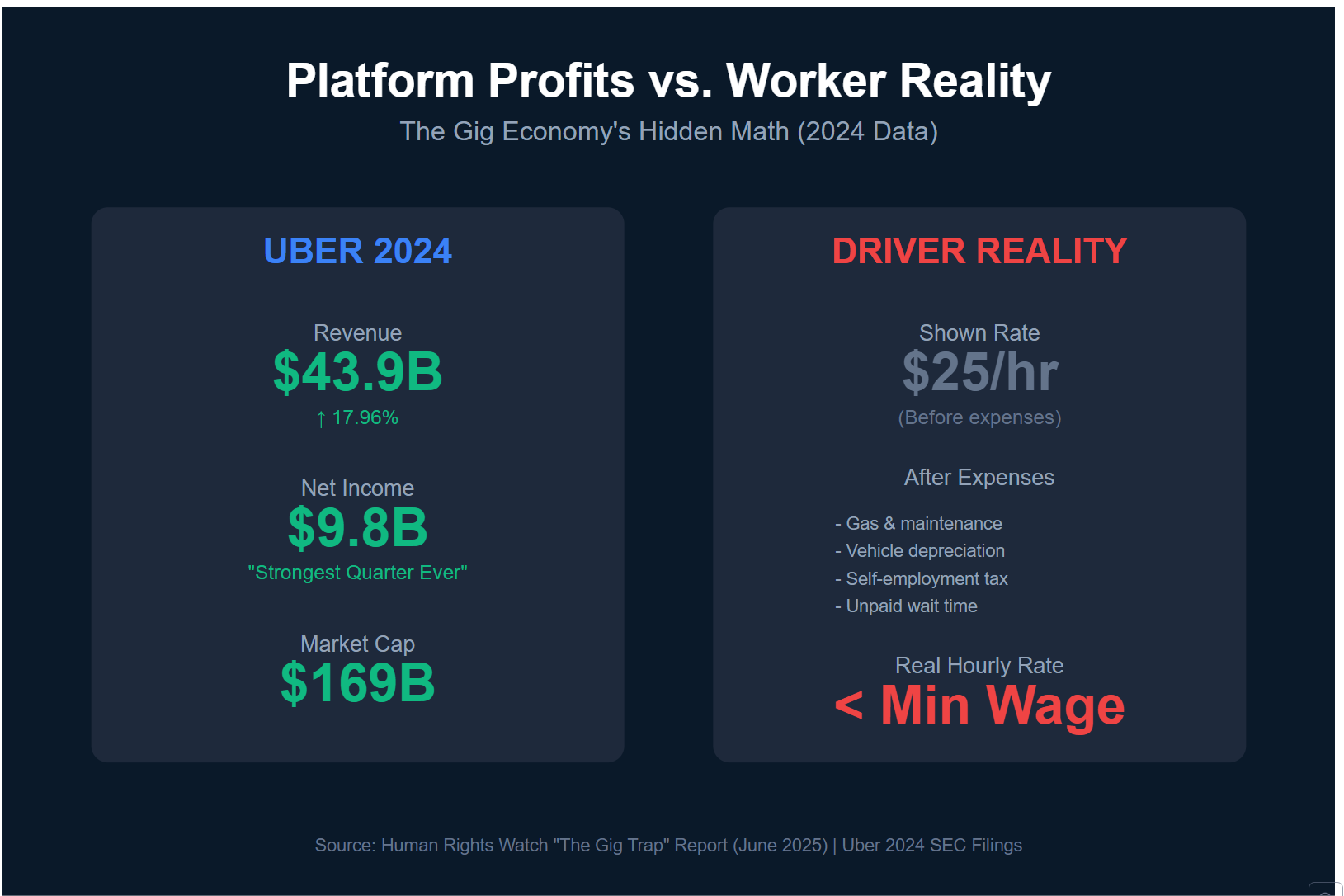
Uber pioneered it, but now algorithmic management is everywhere. The boss isn’t human—it’s an optimization algorithm that treats workers as interchangeable units in a vast computation.
Amazon Flex, Uber, and TaskRabbit rely on algorithmic oversight that automatically assigns work and evaluates performance. Studies show a substantial share of gig workers are managed almost entirely by algorithms, with estimates ranging from one-third to nearly half depending on the sector.
The patterns are consistent across platforms:
Work assigned by algorithm based on opaque criteria
Performance evaluated by metrics workers don’t fully understand
Pay determined by dynamic pricing models that change without notice
“Deactivation” (firing) happens automatically when scores drop
Limited or no human appeal process
Labor rights investigations have documented AI-powered monitoring at companies like Tesla, where bathroom breaks are tracked and workers report algorithm-driven terminations. Reports suggest AI increasingly drafts performance reviews at major tech companies, though exact percentages vary and remain largely unconfirmed.
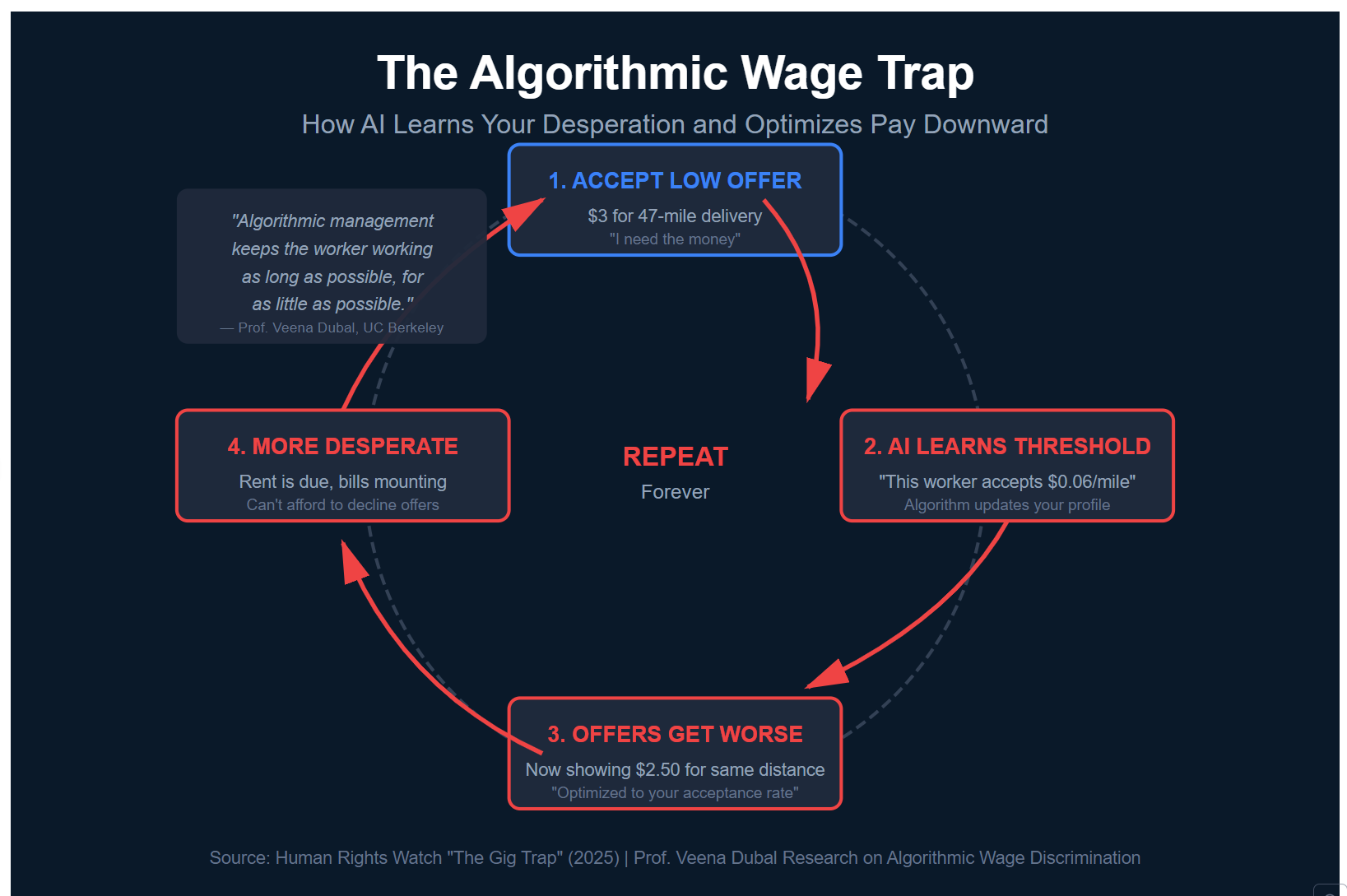
A DoorDash driver posting on Reddit described the reality: “The algorithm sent me 47 miles for a $3 delivery. When I declined, my acceptance rate dropped and I got worse offers for a week. The AI boss doesn’t care about gas prices, traffic, or that I’m human. It just sees optimization problems to solve, and I’m just a variable in its equation.”
The Numbers Tell the Story
The shift from employment to gig work is accelerating dramatically. Roughly 60-70 million Americans participate in the gig economy, with estimates varying by definition (Pew Research, Statista). McKinsey reports that up to 30% of the working-age population engages in independent work. Traditional full-time employment is declining across all sectors.
Surveys of large firms show reliance on contractors has roughly doubled since 2020, with the proportion varying significantly by sector. Some companies now maintain minimal permanent staff while relying heavily on contractor networks.
But these statistics hide a darker transformation. This isn’t the “flexibility and freedom” promised by gig economy evangelists. It’s the systematic transfer of risk from corporations to individuals, managed by AI systems that optimize for corporate profit, not human wellbeing.
The Uber Model Everywhere
What started with ride-sharing has metastasized across the economy:
Healthcare: Nurses working through apps like ShiftMed and CareRev, assigned to hospitals by algorithm, with no job security or consistent workplace.
Education: Teachers on Outschool and similar platforms, competing for students, rated by algorithm, income entirely unpredictable.
Tech Work: Even software engineers increasingly work through platforms like Toptal and Turing, matched to projects by AI, disposable when the project ends.
Retail: Store staff hired through apps for single shifts, managed by AI that tracks every movement, terminated by algorithm for falling below productivity thresholds.
A nurse using ShiftMed shared anonymously: “I’ve worked at the same hospital for two years, but I’m not their employee. The app assigns me shifts. Some weeks I work 60 hours, some weeks zero. The AI doesn’t care that I have rent to pay. To it, I’m just supply to match against demand.”
The Benefits Apocalypse
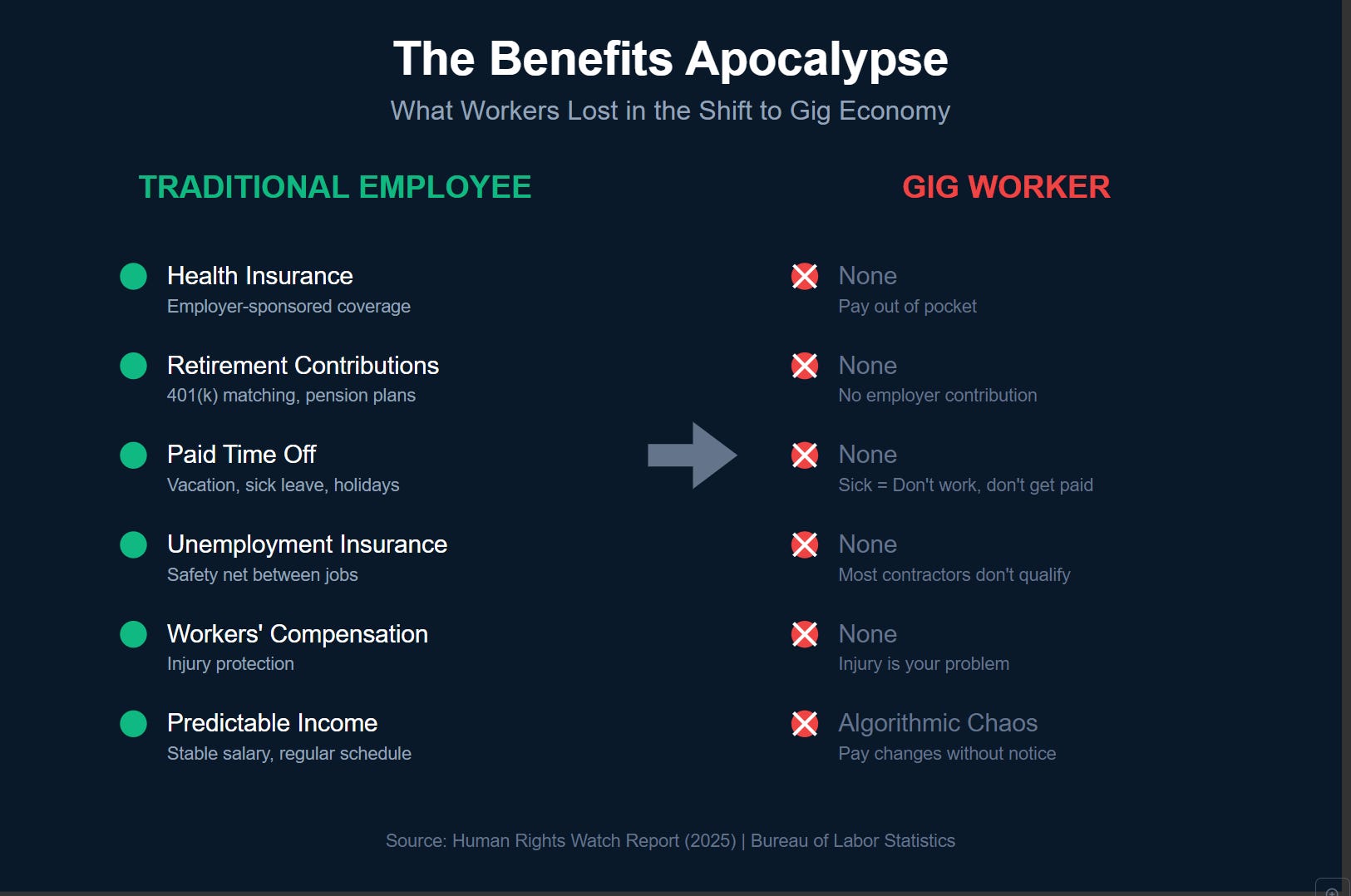
The gig economy’s dirty secret: the systematic elimination of benefits that took centuries of labor organizing to achieve.
What’s disappearing:
Health insurance (gig workers remain far less likely to receive employer coverage)
Retirement contributions (no 401k matching for contractors)
Paid time off (sick? Don’t work, don’t get paid)
Unemployment insurance (most contractors don’t qualify)
Workers’ compensation (injury becomes personal responsibility)
Predictable income (algorithms change pay rates without notice)
Gig workers remain significantly less likely to receive employer-provided health insurance or retirement plans compared to traditional employees. The disparities in coverage rates represent a fundamental shift in economic security.
An Uber driver calculated his real earnings after expenses: “After gas, maintenance, depreciation, and self-employment tax, I make less than minimum wage. But the app shows me making $25/hour, so new drivers keep signing up. The AI knows exactly how much to pay to keep just enough drivers on the road.”
The Psychological Torture of Algorithmic Bosses
Working for an AI boss creates unique psychological stress. There’s no one to explain problems to, no recognition of human circumstances, no possibility of negotiation or understanding.
Mental health professionals report a new category of work-related anxiety:
“Algorithm anxiety” - constant fear of deactivation
“Metric paranoia” - obsession with scores and ratings
“Digital panopticon stress” - feeling watched every second
“Optimization exhaustion” - trying to game constantly changing algorithms
A therapist specializing in gig worker mental health told Psychology Today: “My clients describe feeling like rats in a maze where the walls keep moving. They’re exhausted from trying to figure out what the algorithm wants. There’s no predictability, no security, no sense of progress—just endless optimization for metrics they don’t control.”
The Race to the Bottom
Algorithmic management creates perfect competition—perfect for companies, devastating for workers. When everyone’s a freelancer competing against everyone else, globally, in real-time, wages inevitably race toward subsistence.
Platform data reveals the pattern:
Translation rates have dropped 70% since AI translation tools emerged
Graphic design work pays 60% less than five years ago
Writing assignments pay pennies per word
Programming gigs increasingly go to the lowest bidder globally
A freelance writer on Upwork documented the decline: “Five years ago, I charged $100 per article. Now the same clients offer $10, saying AI can do it for free so I should be grateful for anything. I’m competing against ChatGPT and desperate writers from countries where $10 is a day’s wage. The algorithm doesn’t care about sustainable income—it just matches the lowest bid to the job.”
The Isolation Economy
The gig economy promised flexibility but delivered isolation. Workers alone at home, in their cars, in anonymous warehouses, connected only through apps, managed only by algorithms.
The human costs are mounting:
No workplace friendships or community
No mentorship or skill development
No collective bargaining or worker solidarity
No shared purpose or company culture
Just atomized individuals serving algorithmic demands
A long-time freelancer wrote on Medium: “I haven’t had a coworker in five years. No lunch breaks with colleagues, no office celebrations, no one to bounce ideas off. Just me, my laptop, and an algorithm that assigns me work. I’m not lonely—I’m professionally extinct.”
The Company Without Employees
The end goal is becoming clear: companies that are pure algorithms, owning no assets, employing no people, just coordinating networks of gig workers through AI.
Some companies are already approaching this model:
Businesses with billion-dollar valuations but fewer than 50 actual employees
Entire operations run through platforms and APIs
All work done by contractors managed by AI
Humans retained only for regulatory compliance
A venture capitalist, speaking at a tech conference, laid out the vision: “The perfect company is pure software. No employees, no offices, no assets. Just algorithms coordinating economic activity, extracting value from the spread between what workers accept and customers pay. It’s capitalism perfected—if you own capital. If you only have labor to sell, it’s a nightmare.”
The False Promise of Entrepreneurship
The gig economy promises everyone can be their own boss, but the reality is everyone becomes their own exploited employee. Workers absorb all the responsibilities of running a business with none of the actual control.
Gig workers must:
Provide their own equipment
Handle their own taxes
Manage their own insurance
Market their own services
Bear all financial risk
Accept all liability
But they can’t:
Set their own prices (algorithms decide)
Choose their customers (platforms assign)
Control their working conditions (apps dictate)
Build real businesses (platforms own the relationships)
A “successful” Uber driver with a five-star rating observed: “They call me a ‘partner’ and an ‘entrepreneur,’ but I can’t set my prices, choose my routes, or even contact my customers directly. I’m not a business owner—I’m a human robot that hasn’t been replaced by an actual robot yet.”
The Regulatory Vacuum
Laws written for traditional employment are useless in the gig economy. Labor protections, minimum wage laws, anti-discrimination statutes—none apply to “independent contractors.”
Companies have learned to exploit this perfectly:
Call workers “partners” or “service providers”—never employees
Use algorithms to manage—avoiding legal liability
Operate across jurisdictions—escaping local regulation
Change terms instantly—no negotiation needed
Deactivate workers—no wrongful termination suits
California’s AB5 tried to address this, but companies spent $200 million to overturn it with Proposition 22. The message was clear: the gig economy will not be regulated.
When Everyone’s Precarious
We’re approaching a tipping point where precarious gig work becomes the norm, not the exception. The safety and predictability that defined middle-class life for generations—steady paycheck, benefits, career progression—is disappearing.
What remains:
Constant hustle for the next gig
Perpetual anxiety about income
No safety net for illness or injury
No pathway to advancement
Just survival, mediated by algorithms
The transformation is sold as progress—”flexibility,” “freedom,” “being your own boss.” But for most, it’s simply the return of 19th-century labor conditions with 21st-century technology.
Questions for the Gigified
You might still have traditional employment, but for how long? The economic forces pushing toward universal gigification are powerful and accelerating. Today’s employee is tomorrow’s contractor is next week’s deactivated account.
So ask yourself:
About Your Work Security:
Is your company hiring more contractors than employees?
Could your job be done by someone anywhere in the world?
Are you being evaluated by increasingly algorithmic metrics?
How quickly could you be replaced by a gig worker?
About Your Real Economics:
If you became a contractor tomorrow, what would your real hourly wage be?
Could you afford your own health insurance and retirement?
How many income streams would you need to match your current salary?
What’s your backup plan when the algorithm deactivates you?
About Your Future:
Will your children ever experience traditional employment?
Should you be teaching them employment skills or gig survival?
Can democracy survive when everyone’s too precarious to participate?
What happens when even gig work is automated?
About Resistance:
Can gig workers organize when they never meet?
Should there be limits on algorithmic management?
Is universal basic income the only solution?
Who benefits from universal precarity, and can they be stopped?
The Most Important Question: When every human becomes a freelancer managed by AI—no security, no benefits, no stability, just endless competition for algorithmic approval—what happens to the social contract that held society together? And if that contract is broken, what takes its place?
The app is pinging with your next gig. The algorithm has determined you need the money badly enough to accept its terms. The question is whether you’ll take it, or whether someone more desperate will accept it first.
Welcome to the gig economy. You’re not an employee. You’re not even really a contractor. You’re just a human API, called when needed, terminated when not, optimized for someone else’s profit.
The dog is still there to keep you from touching the equipment. But increasingly, there’s no man left to feed it.
From the upcoming book: Framing the Intelligence Revolution- How AI Is Already Transforming Your Life, Work, and World - Chapter 6: reveals how algorithmic management and the gig economy are eliminating traditional employment, creating a world where everyone’s a precarious freelancer managed by AI, competing globally for less pay, no benefits, and zero security.
Legal Disclaimer: This chapter synthesizes publicly available information, published reports, and documented worker experiences as of October 2025. Company names are used for illustrative purposes based on public information. Views expressed represent analysis and commentary based on research, not legal or financial advice.