


By Dr. Elias Kairos Chen
Something happened in Washington this month that I have been waiting two years to see.
On June 6, Senator Bernie Sanders proposed that the American public take a 50% ownership stake in major AI companies, using their equity to create a public wealth fund that would distribute the fortune generated by the AI giants. The same week, OpenAI CEO Sam Altman requested a private meeting with Sanders and told him that he, too, wants the public to have equity in AI companies. He could not support the 50% figure, but he wanted to work together on the principle. And in parallel, the Trump administration and OpenAI confirmed they have been in talks for over a year about the U.S. government taking an equity stake in the company, seeding what OpenAI’s own April policy proposal called a “Public Wealth Fund.”
Trump. Sanders. Altman. Three figures who agree on almost nothing, converging on the same idea: the public should own a piece of the AI economy.
I want to be direct about why this matters to me. In my earlier work, I argued that the entire debate about how to support people through the AI transition was being framed incorrectly. The question was never “how much cash should we pay displaced workers?” The question was always “who owns the intelligence that is displacing them?” The shift from income to ownership is the single most important reframing of the economic transition. And it is now happening at the highest levels of the U.S. government, across the political spectrum, in the same week.
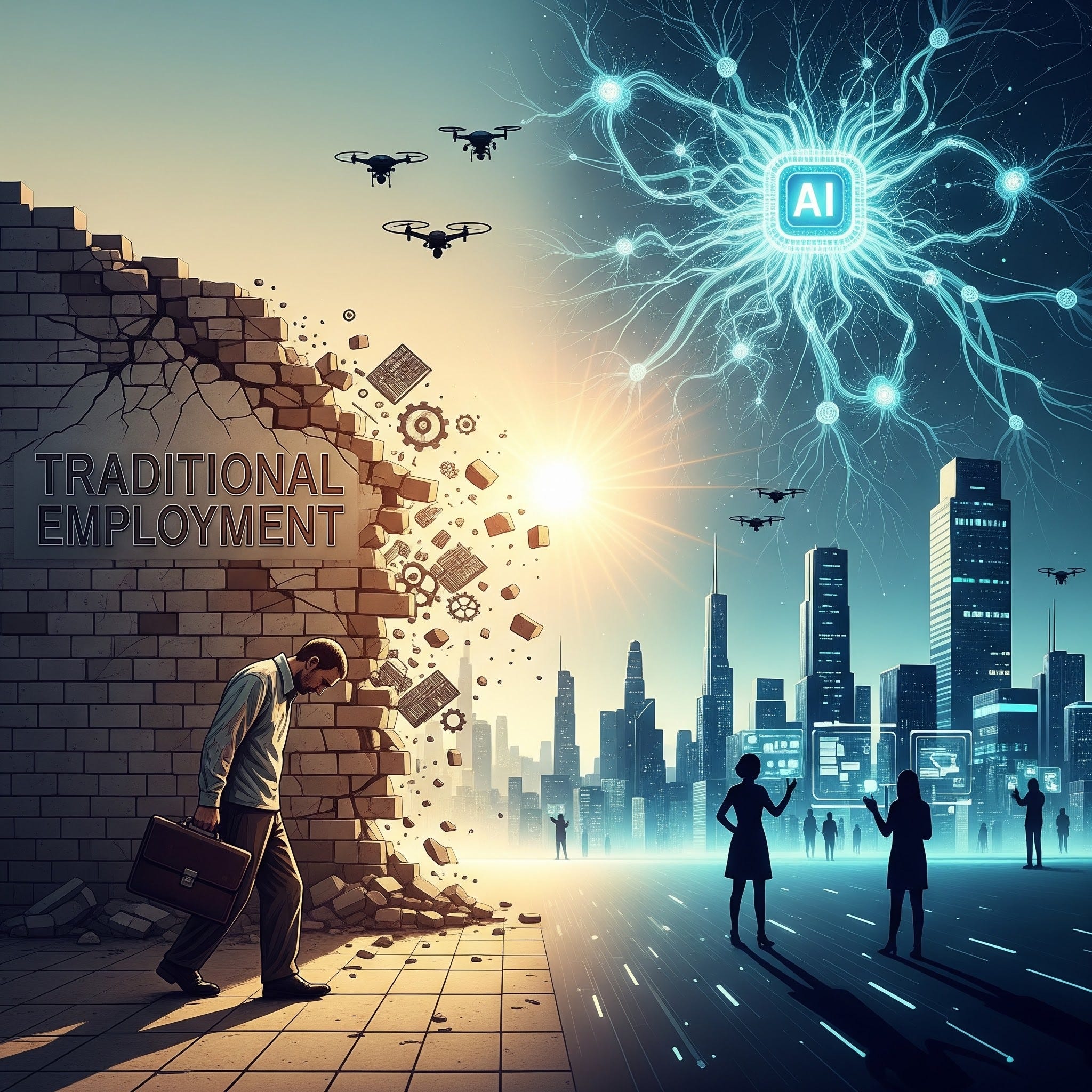
This is the story of how employment died and what comes next. And for once, the institutions are starting to ask the right question.
The man who funded UBI just walked away from it
To understand how significant this moment is, you have to understand who Sam Altman is in this debate.
Altman is not a casual observer of universal basic income. He is the single most important funder of UBI research in American history. Through his nonprofit OpenResearch, he raised $60 million, including $14 million of his own money, to run the largest and most rigorous basic income experiment ever conducted in the United States. From November 2020 to October 2023, the study gave 1,000 low-income participants $1,000 per month, with a control group of 2,000 receiving $50. He did this because he believed that as AI eliminated jobs while concentrating wealth, guaranteed cash payments would become necessary.
In May 2026, Altman publicly stepped back. “I no longer believe in universal basic income as strongly as I once did,” he said. His reasoning is precisely the argument I have been making in this series. Fixed cash payments, he now argues, will not be enough to address the inequality and concentration of wealth that AI will produce. What is needed, in his words, is “a collective alignment around shared gains.” The conversation, he said, must shift from “how much cash should be paid” to “who owns the means of production and the benefits of growth in the AI economy.”
That is the UBI-to-UBC pivot. From Universal Basic Income to Universal Basic Capital. From keeping people alive to giving them a stake. And it is being led by the man who spent $14 million of his own money proving that cash alone is insufficient.
His own experiment told him why. The results, released in 2024, were sobering for cash advocates. Recipients spent more on basic needs, which was good. But the study found no significant improvement in physical or mental health, and recipients’ own earned income fell by about $125 per month, partially offsetting the transfer. The cash kept people afloat. It did not transform their circumstances. It did not give them ownership of anything. It did not change their position in the economy. It just made the waiting slightly more comfortable.
This is the core limitation I have been pointing to. UBI keeps people alive. It does not help them transform. And in an economy where AI is absorbing the means of production itself, keeping people alive while the ownership of intelligence concentrates among a handful of companies is not a solution. It is a holding pattern that entrenches the very inequality it claims to address.
Why employment was the wrong thing to save
For most of the past three years, the policy conversation has been about saving jobs. Reskilling programmes. Training initiatives. Wage subsidies. Job guarantees. Every institution from the World Economic Forum to national labour ministries has framed the challenge as a question of employment: how do we keep people in jobs as AI advances?
I understand the instinct. Employment has been the organising principle of human economic life for three centuries. It is how income is distributed, how dignity is conferred, how people structure their days and their identities. The reflex to save it is natural.
But it is the wrong target. As I argued in a previous article, AI does not just automate tasks. It substitutes for the human capability that made labour valuable in the first place. When the scarce input becomes abundant, its market price approaches zero. You cannot save employment by training people to compete with a system that performs their cognitive function at near-zero marginal cost and improves every few months. You are training them to lose a race that is being run on an exponential track.
The Five Economies I described in Week 16 make this concrete. The automation economy is repricing human labour downward. The repricing economy is rehiring workers at lower wages. The psychological economy is filling with fear, with 43% of workers expecting automation to take their jobs within two years. Saving employment in this environment means preserving a structure that is actively being dismantled by the technology, the markets, and the incentives all at once.
The right target was never employment. It was income security and economic participation, which employment used to provide but no longer reliably does. Once you separate those two things, the question changes entirely. The question is no longer “how do we keep people employed?” It is “how do people maintain income and participate in the economy when employment is no longer the mechanism?”
And that question has a different set of answers.
What actually replaces the labour-for-income model
I have been developing a set of frameworks for what comes after employment. None of them is complete. All of them are necessary to think about now, because the transition is already underway and the institutions are only beginning to catch up.
Universal Basic Capital. This is the centrepiece, and it is exactly where Altman, Sanders, and even the Trump administration are now converging. Instead of giving people cash to consume, you give them ownership of the productive assets generating the wealth. A share of the AI infrastructure. Equity in the companies. A stake in the compute. The principle is that if intelligence becomes the means of production, then broad ownership of that intelligence is the only way to prevent the catastrophic wealth concentration that every serious analyst now anticipates. Sanders proposes 50% public ownership. Altman proposes something smaller but real. OpenAI proposes a Public Wealth Fund seeded by donated equity. These are all variations on Universal Basic Capital, and the fact that they are being debated seriously is the most encouraging development of the past year.
Universal Basic Intelligence. Ownership of capital addresses income. But there is a second form of participation that matters just as much: access to capability. Universal Basic Intelligence means guaranteed access to AI tools that amplify human potential, provided as infrastructure rather than purchased as a product. Altman himself has gestured at this, suggesting that individuals could be given a portion of AI compute to use, sell, or trade. The logic is sound. In an economy where AI access determines what you can do and become, making that access universal is the equivalent of universal literacy in the industrial age. Not charity. Infrastructure. UBI keeps you alive. UBC gives you a stake. UBInt keeps you capable. The three work together.
The Human Prosperity Index. If employment is no longer the measure of economic health, and if Khosla is right that GDP itself becomes less meaningful, then we need a new way to measure whether the economy is actually working for people. I have proposed five dimensions: Material Abundance, Capability Access, Agency Preservation, Sustainability Balance, and Social Cohesion. The point is that an economy producing enormous output while concentrating ownership and stripping people of agency is not succeeding, no matter what GDP says. The HPI is designed to see the failure that aggregate growth statistics hide.
There is precedent for ownership-based distribution that works. Alaska’s Permanent Fund Dividend has paid every resident an annual share of the state’s oil wealth since 1982. Norway’s sovereign wealth fund, built from oil revenues, now owns roughly 1.5% of every listed company on Earth on behalf of its citizens. Both demonstrate that broad-based ownership of a productive resource can distribute wealth without destroying incentives. The question is whether intelligence, the productive resource of the coming era, can be owned the same way oil was. Altman’s suggestion that individuals receive a portion of AI compute to use, sell, or trade is a direct echo of the Alaska model, applied to the resource that matters now.
But there is a crucial difference. Oil sits within national borders. Intelligence does not. A sovereign wealth fund built on oil benefits the citizens of the country that owns the oil. A public wealth fund built on AI benefits the citizens of the country that hosts the AI company. And as David Autor pointed out, this leaves a haunting question: what happens to the billions of people who lose their livelihoods to AI but live in countries that own none of it? The ownership reframing solves the distribution problem within wealthy AI-producing nations. It does nothing for the rest of the world. That is a Layer Three Geopolitics problem hiding inside a Layer Three Economy solution, and I will return to it in future work.
The danger in getting this right
I want to be careful here, because there is a version of this transition that goes badly even if the ownership reframing succeeds.
Public ownership of AI sounds democratic. But it depends entirely on the design. A public wealth fund controlled by a government that is also capturing AI productivity gains could become a mechanism of control rather than liberation. Sanders himself noted that his 50% threshold was about decision-making power, not just financial returns, and that he and Altman did not reach agreement on that point. The difference matters. Owning a financial stake in AI companies while having no say in how they operate is a dividend, not democracy. It keeps people fed while leaving the fundamental power structure untouched.
David Autor, the MIT labour economist, has warned that a society where the majority of income is distributed from a few concentrated sources is a “political fantasy land” and a frightening one. He is right to worry. If a handful of AI companies generate most of the economic value, and the public receives a share through a government-managed fund, then the entire population becomes dependent on the continued success and goodwill of those companies and that government. That is not economic participation. It is a new form of dependency dressed in the language of ownership.
The design question is everything. Universal Basic Capital done well means broad, direct, individual ownership with real governance rights. Universal Basic Capital done badly means a centralised fund that pacifies the population while entrenching the power of whoever controls it. The same policy can liberate or subjugate depending on how the ownership and the control are structured.
This is why I keep returning to agency in my frameworks. The Agency Preservation dimension of the Human Prosperity Index is not decorative. It is the safeguard against a future where people are materially comfortable but structurally powerless. An economy can deliver abundance and still fail its people if it strips them of the capacity to shape their own lives.
What I am seeing on the ground
In my advisory work across more than twenty countries, I have watched this realisation arrive in boardrooms, usually late and usually reluctantly. A year ago, the executives I worked with wanted to talk about productivity gains and efficiency. They wanted AI to do more with fewer people, and they wanted help managing the transition quietly.
Increasingly, the conversation has changed. The more thoughtful leaders have started asking a different question, one that has nothing to do with their quarterly results. They ask what happens to their workforce, their communities, and their customers when the model they are building scales across the entire economy. They have begun to understand that a company can win the automation race and still lose, because a workforce with no income is also a market with no customers. The demand problem I described in Week 15 is starting to register where it matters.
This is the quiet shift beneath the public one. The ownership conversation in Washington is the visible tip. Beneath it, in private, the people actually deploying these systems are beginning to grasp that the labour-for-income model collapsing is not someone else’s problem. It is the foundation their own businesses stand on. You cannot sell to a population you have economically stranded. The intelligence economy needs consumers, and consumers need income, and income now requires a mechanism other than employment.
That mechanism is ownership. And the leaders who understand this first will shape what the new model looks like.
What this moment actually means
For two years, the institutions asked the wrong question. They asked how to save employment, and they built reskilling programmes and wage subsidies and training initiatives designed to keep people in jobs that the technology was actively eliminating.
This month, the question finally changed. When Trump, Sanders, and Altman independently arrive at public ownership of AI in the same week, the conversation has shifted from preserving the old model to designing the new one. That is progress. It is the right question, finally being asked at the right level.
But asking the right question is not the same as getting the right answer. The ownership reframing opens the door to genuine economic transformation, and it opens the door to a more sophisticated form of dependency. Which one we get depends on decisions being made right now, mostly by people who have not thought carefully about the difference.
Employment is dead. Not entirely, not everywhere, not all at once. But as the organising principle of economic life, as the reliable mechanism through which people earn income and participate in the economy, it is ending. The labour-for-income model that governed three centuries of human history is being dismantled in real time.
What replaces it is not yet decided. The frameworks exist. Universal Basic Capital for ownership. Universal Basic Intelligence for capability. The Human Prosperity Index for measurement. The political will is beginning to form, visible in a Senate office in Washington and a policy proposal from the world’s leading AI company. The question is whether we build the version that gives people a genuine stake and genuine agency, or the version that gives them a comfortable seat in a system they no longer control.
That choice is the next chapter. And unlike employment, it is not yet dead. It is still ours to make.
“Framing the Future of Superintelligence,” a series documenting the transformation unfolding faster than anyone anticipated.
Dr. Elias Kairos Chen is the author of “Framing the Intelligence Revolution: How AI Is Already Transforming Your Life, Work, and World” and a strategic advisor on AI transformation across many countries.
Next week: The Singapore Test Case — can the world’s most AI-forward government actually build the bridge?