


Amazon just told us the future, and nobody’s paying attention.
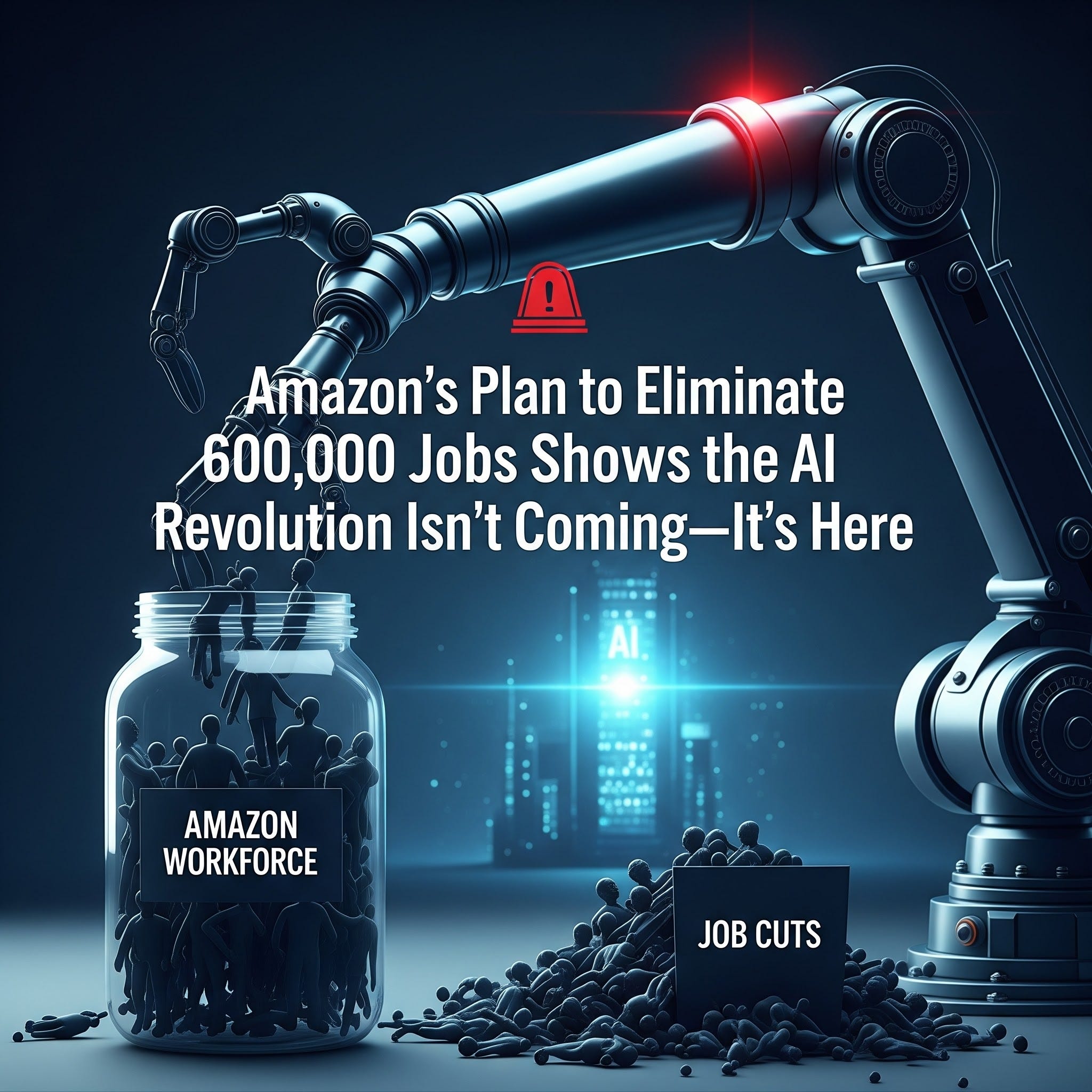
Last week, The New York Times reported on leaked internal documents and management interviews revealing Amazon’s plan to replace 600,000 warehouse workers with robots. Not someday. By 2027. That’s 24 months away.
The same week, NVIDIA announced partnerships to build the AI infrastructure that makes this possible: quantum-AI supercomputers with the Department of Energy, 100,000 autonomous robotaxis with Uber, robot factories building GPUs autonomously.
These aren’t separate stories. They’re the same story.
Amazon’s documents reveal the automation playbook for physical work. NVIDIA’s announcements show the infrastructure being built for cognitive work. Together, they map the next decade of job displacement—and it’s happening faster than almost anyone realizes.
Here’s what the leaked Amazon documents actually say: The robotics plan would automate an estimated 75% of the company’s operations, resulting in a workforce reduction of 160,000 by 2027. The ultimate goal? Replace 600,000 warehouse workers with robots, achieving an estimated 30% cost savings per product by 2027.
For context: Amazon employs 1.5 million people globally. This isn’t trimming around the edges. It’s eliminating 40% of the workforce in one of America’s largest employers.
The economics are overwhelming: Lower operating costs translate to higher valuations. The robotics plan could save Amazon roughly $12.6 billion from 2025 to 2027. That influx helps offset the company’s massive AI capital expenditures—$385 billion across the big five tech companies this year alone.
But here’s what matters more than Amazon’s bottom line: This is the template. The playbook every company will follow. The pattern repeating across every sector.
And the infrastructure to execute it globally is being built right now, on specific timelines, with government backing.
I. THE PATTERN NOBODY’S CONNECTING
Amazon Shows How Physical Work Disappears
According to Bloomberg’s analysis of the leaked documents, only 350,000 of Amazon’s 600,000 targeted roles are in corporate offices. The robotics plan targets warehouse workers—the people who pick, pack, and move products in fulfillment centers.
The timeline:
2025-2026: Robotics deployment accelerates across fulfillment centers
2027: 160,000 workers eliminated, 75% of operations automated
2027-onwards: Full 600,000 worker displacement as cost savings compound
The technology enabling it:
DeepFleet (Amazon’s generative AI foundation model): Improves robot fleet travel efficiency by 10%
Warehouse robotics (Proteus, Cardinal, Sparrow): Handle sorting, moving, picking
Computer vision and machine learning: Route optimization, predictive maintenance
Integration across 350+ fulfillment centers globally
The economics that make it inevitable:
Human worker fully-loaded cost: ~$35,000-45,000/year (wages, benefits, insurance, training)
Robot amortized cost: ~$15,000-20,000/year (capital, maintenance, energy)
Utilization: Robots operate 20+ hours/day vs. human 8-hour shifts
Consistency: Zero sick days, breaks, turnover, or unionization risk
The math is brutal: A robot that costs less than half as much and works 2.5x longer hours isn’t just competitive—it makes human labor economically obsolete.
NVIDIA Shows How the Infrastructure Gets Built
While Amazon plans warehouse automation, NVIDIA is building the infrastructure that makes AI-driven automation possible at scale—across ALL sectors.
What NVIDIA announced (October 28, 2025, Washington DC):
1. Federal AI Data Centers
Government fast-tracking AI data centers on federal land
Target operational: Late 2027
These aren’t just bigger data centers—they’re “AI factories” for training and running advanced AI systems
Once operational, too economically valuable to shut down
2. Quantum-AI Hybrid Supercomputers
Partnership with Department of Energy for 7 quantum supercomputers
Integration layer (NVQLink) connecting quantum processors to GPUs
Operational timeline: 2027-2028
Why this matters: Quantum accelerates AI training exponentially, not linearly
3. 100,000 Autonomous Robotaxis
Partnership with Uber, deploying starting 2027
Using NVIDIA DriveOS and AI chips
6 million Uber drivers globally in the crosshairs
Same automation playbook as Amazon, different sector
4. Robot Factories Building GPUs
Partnership with Foxconn for autonomous factory in Texas
Robots building the chips that power robots
Operational: 2027
The exponential loop: AI builds better AI, robots build more robots
5. Physical AI Foundation Models
NVIDIA Isaac GR00T N1: Open foundation model for humanoid robots
Released to robotics developers globally
Makes humanoid robot development 10x faster
Cost parity with human labor: 2030 projection
The convergence pattern:
2025-2026: Infrastructure deployment (data centers, quantum systems, factory construction)
2027-2028: Systems operational and proving economics
2028-2030: Rapid scaling across sectors
2030-2035: Automation becomes standard, not exceptional
II. WHY THIS TIME IS DIFFERENT: THE PHYSICAL + COGNITIVE CONVERGENCE
Previous automation waves replaced EITHER physical OR cognitive tasks. This wave replaces BOTH simultaneously.
The Old Pattern: Separated Domains
Industrial Revolution (1800s-1900s):
Machines replaced physical labor (textiles, manufacturing)
Created new cognitive jobs (engineering, management, design)
Timeline: 100+ years of adaptation
Digital Revolution (1980s-2020s):
Computers replaced cognitive routine work (bookkeeping, data entry)
Created new cognitive jobs (programming, analysis, design)
Physical work largely untouched
Timeline: 40 years of adaptation
The New Pattern: Simultaneous Replacement
AI Revolution (2025-2040):
AI replaces cognitive work (analysis, writing, design, diagnosis)
Robots replace physical work (warehouse, driving, manufacturing, delivery)
Happening simultaneously across all sectors
Timeline: 15 years from deployment to transformation
What makes this possible now:
AI reaches human-competitive performance
GPT-5 demonstrates “PhD-level intelligence” in multiple domains
AI diagnostics outperform doctors in specific medical imaging
Legal AI does document review better than junior lawyers
Timeline for AGI: 25% probability by 2027, 50% by 2031 (Metaculus forecasters)
Robotics reaches deployment viability
Humanoid robots demonstrating complex manipulation
Cost parity with human labor projected by 2030
Foundation models (like NVIDIA Isaac GR00T) accelerate development
Amazon, Tesla, Boston Dynamics, Figure all deploying
Infrastructure reaches scale
Federal AI data centers operational 2027
Quantum-AI systems online 2027-2028
5G/6G networks enable real-time robot coordination
Cloud computing makes AI accessible to all companies
Economics become overwhelming
Companies that don’t automate get out-competed
Shareholders demand efficiency (Amazon’s stock up on automation news)
International competition prevents slowing down
First-mover advantages lock in market position
Result: No job is truly safe. Physical and cognitive work both automating on compressed timelines.
III. THE SECTOR-BY-SECTOR ROLLOUT
Amazon and NVIDIA announcements reveal the pattern that will repeat across industries.
PHYSICAL WORK: 2025-2035
Warehousing & Logistics (Amazon Model)
Workers affected globally: 60 million
Timeline: 2025-2030 for major transformation
Pattern:
Company announces robotics plan (✓ Amazon just did)
2-3 years deployment (2025-2027)
Workforce reduction 40-60% (2027-2030)
Complete transformation by 2030-2032
Examples: Amazon (600K jobs), Walmart, Alibaba, JD.com all following same path
Transportation (NVIDIA-Uber Model)
Workers affected globally: 150 million drivers
Timeline: 2027-2035 for profession elimination
Pattern:
Technology proves viability (✓ millions of autonomous miles)
Major deployment announced (✓ NVIDIA-Uber 100K vehicles 2027)
Economic tipping point (✓ robotaxis 40% cheaper)
Mass displacement (2028-2032)
Examples: Uber, Lyft, DiDi, Grab, taxi companies globally
Manufacturing (Foxconn Model)
Workers affected globally: 100 million+
Timeline: 2027-2035 for lights-out factories
Pattern:
Pilot lights-out factories (✓ Foxconn Texas 2027)
Cost savings prove model (30-50% reduction)
Rapid geographic spread (2028-2032)
Human workers niche only by 2035
Examples: Foxconn, Tesla, BMW, Toyota, electronics manufacturing globally
Food Service & Retail
Workers affected globally: 200 million+
Timeline: 2028-2035
Examples: McDonald’s kiosks, Amazon Go stores, robot baristas, automated checkout
COGNITIVE WORK: 2027-2035
While physical work automates, AI targets cognitive work simultaneously:
Legal Services
Workers affected globally: 10 million lawyers
Timeline: 2025-2030 for major disruption
What AI does: Document review, legal research, contract analysis, case prediction
Result: 30-50% of legal jobs automated, junior positions eliminated
Healthcare Diagnostics
Workers affected globally: 15 million radiologists, pathologists, diagnosticians
Timeline: 2026-2032
What AI does: Medical imaging analysis, pathology screening, diagnostic suggestions
Result: Radiologists and pathologists most vulnerable, AI-augmented doctors new standard
Finance & Accounting
Workers affected globally: 20 million accountants, financial analysts
Timeline: 2025-2030
What AI does: Tax preparation, auditing, financial analysis, reporting
Result: Entry-level accounting eliminated, analytical roles compressed
Customer Service
Workers affected globally: 50 million+
Timeline: 2024-2028 (already happening fast)
What AI does: Chatbots, voice AI, automated responses
Result: Call centers mostly eliminated by 2028
Software Engineering
Workers affected: 25 million globally
Timeline: 2027-2033
What AI does: Code generation, debugging, testing, documentation
Result: Junior developers eliminated, senior roles transform to AI management
IV. THE GLOBAL PATTERN: SAME PLAYBOOK, DIFFERENT TIMELINES
The Amazon-NVIDIA template plays out globally with variations in speed, not outcome.
United States: Fast Deployment, Weak Safety Net
Timeline: 2027-2032 for major transformation
Characteristics:
Private sector drives automation (Amazon, tech companies lead)
State-by-state regulatory patchwork (minimal federal intervention)
Weak social safety net (unemployment insurance inadequate)
Strong shareholder pressure for efficiency
Amazon’s US workforce most affected:
950,000 US employees (of 1.5M global)
400,000+ in fulfillment centers (target for automation)
Geographic concentration in logistics hubs (Rust Belt, Sun Belt)
Result: Fastest automation, largest displacement, minimal support for workers
China: Aggressive Deployment, State Control
Timeline: 2027-2030 for major transformation (faster than US)
Characteristics:
Government-backed automation as national priority
“Made in China 2025” + AI = lights-out factories
State can absorb displaced workers (infrastructure projects, mandatory retraining)
Social stability concerns drive policy
Chinese automation examples:
Alibaba’s automated warehouses (already operational)
Baidu’s autonomous vehicle deployment (10,000+ vehicles)
Manufacturing automation (Foxconn, BYD going lights-out)
Result: Fastest deployment globally, state-managed displacement, authoritarian control
Europe: Slower Deployment, Stronger Protections
Timeline: 2029-2034 for major transformation (slower due to regulation)
Characteristics:
Heavy labor protections (harder to eliminate jobs)
GDPR and AI Act create regulatory friction
Strong social safety nets (cushion displacement)
Worker councils have input
European automation:
Amazon’s European fulfillment centers (200,000+ workers)
Automotive manufacturing (BMW, Mercedes automating)
Warehouse automation delayed 2-3 years vs. US/China
Result: Slower automation, same endpoint, better worker support in transition
Developing Economies: Delayed Deployment, Larger Impact
Timeline: 2030-2035 (infrastructure lag delays but doesn’t prevent)
Characteristics:
Labor cost advantage erodes (robots eventually cheaper everywhere)
Infrastructure limitations delay deployment
Weaker safety nets mean catastrophic impact
Large informal economies complicate transition
Examples:
India: 2.5M taxi drivers, 200M manufacturing workers vulnerable
Southeast Asia: 9M Grab/Gojek drivers, massive manufacturing sector
Latin America: Manufacturing and logistics employment at risk
Africa: Leapfrog potential (skip human labor phase) but also massive displacement risk
Result: Delayed but inevitable, weakest support systems, potentially catastrophic social impact
V. WHY THE TIMELINE IS FASTER THAN YOU THINK
Every expert prediction for automation timelines has been wrong—consistently too slow.
The Compression Pattern
2020 predictions for AGI: 2060 (40 years away) 2023 predictions for AGI: 2035 (12 years away) 2024 predictions for AGI: 2028-2031 (4-7 years away) Current reality: 25% probability by 2027 (2 years away)
Why this keeps happening:
1. Exponential Progress, Linear Thinking
AI capabilities doubling every 6-10 months
Most people extrapolate linearly (next year = this year + modest improvement)
Reality: exponential curves look flat, then vertical
2. Infrastructure Lock-In Accelerates
Once federal AI data centers operational (late 2027), training costs plummet
More training → better models → more applications → more training
Virtuous cycle accelerates faster than anticipated
3. Quantum Factor
Quantum-AI hybrid systems operational 2027-2028
Problems that take months on classical computers take hours on quantum
AI training accelerates 100-1000x in specific domains
Timeline predictions based on classical computing become obsolete
4. Economic Forcing Functions
Amazon announces 600K job automation → Stock rises → Walmart must follow
Company that doesn’t automate gets out-competed
Shareholders demand efficiency
Race to automate accelerates timeline
5. International Competition
US vs. China AI race eliminates ability to slow down
Neither can afford to let other get ahead
“Safety” becomes secondary to “winning”
Deployment happens despite concerns
Result: Every sector transforms 5-10 years faster than current mainstream predictions.
VI. THE INFRASTRUCTURE LOCK-IN: WHY IT’S TOO LATE TO STOP
Here’s the uncomfortable truth: The decisions that determine the next 30 years are being made RIGHT NOW, mostly in private, with little public input.
What’s Being Built (Physical Reality, Not Theory)
Federal AI Data Centers
Construction timeline: 2025-2027
Operational: Late 2027
Investment: Tens of billions
Once built: Too valuable to mothball, too integrated to shut down
Quantum-AI Research Centers
NVIDIA Boston facility (announced March 2025)
DOE partnership for 7 quantum supercomputers
Research collaborations with 17 quantum companies
Once operational: Capabilities can’t be un-invented
Robot Manufacturing Infrastructure
Foxconn Texas facility (announced October 2025)
Tesla’s production lines increasingly automated
Amazon’s fulfillment center retrofits (ongoing)
Once deployed: Economics favor keeping, not reversing
6G AI-Native Networks
NVIDIA-T-Mobile-Nokia partnership (October 2025)
Infrastructure designed for AI-to-AI communication
Embedded in cell towers, not just software
Once deployed: The physical layer of AI infrastructure
The Lock-In Timeline
2025-2026: The Decision Window (NOW)
Infrastructure plans finalized
Regulatory approvals sought (and mostly granted)
Construction/deployment begins
Public awareness minimal
This is the moment for intervention—but it’s not happening
2027-2028: The Operational Phase
Federal AI data centers go live (late 2027)
Quantum-AI systems operational (2027-2028)
Amazon’s first 160,000 workers displaced (2027)
NVIDIA-Uber robotaxis launching (2027)
Economic benefits become visible, political will to stop evaporates
2028-2030: The Acceleration Phase
Infrastructure proves economics
Competitors rush to catch up
Geographic spread (US → China → Europe → Developing)
Displacement becomes undeniable
Too late to stop, only mitigate
2030+: The New Normal
Automation standard, not exceptional
Human labor premium, not default
Economic models fundamentally restructured
Social systems struggling to adapt
Decisions made 2025-2027 determine this reality
Why It’s Hard to Stop
1. Economic Dependencies Form Fast
Jobs created in construction, maintenance, operation
Local governments depend on tax revenue
Supply chains reorganize around new infrastructure
Shutting down becomes economically painful
2. International Competition Prevents Coordination
If US slows down, China accelerates
First-mover advantages lock in for decades
No country can afford to fall behind
Prisoner’s dilemma at global scale
3. Corporate Capture of Regulatory Process
Amazon, NVIDIA, tech giants lobbying heavily
Revolving door (regulators → tech companies → regulators)
Campaign contributions dwarf worker advocacy
Rules written by those they’re supposed to regulate
4. Public Awareness Lags Reality
Infrastructure decisions technical and boring
Media covers AI ethics debates (abstract)
Actual deployment decisions happen quietly
By the time public realizes, infrastructure operational
5. The “Jobs of the Future” Narrative
“Automation creates more jobs than it destroys” (historically true, may not be this time)
“We’ll retrain workers” (timeline mismatch: automation 5-7 years, retraining effective career length)
“AI will augment, not replace” (true for some, not true for Amazon’s 600K workers)
Narrative provides political cover for inaction
VII. WHAT THIS MEANS FOR YOU (SECTOR BY SECTOR)
If You Work in Warehousing/Logistics
Your timeline: 2025-2030
Amazon just showed the playbook: 600K jobs eliminated by 2027-ongoing
Every logistics company (Walmart, Target, UPS, FedEx, DHL) following same path
Your job likely automated within 5 years
What to do:
Exit now if possible (transition while employed)
Retrain for roles robots can’t do (complex problem-solving, human services)
Build financial cushion (job loss likely sudden)
Don’t wait for employer to announce—plan is already made
If You Drive for a Living
Your timeline: 2027-2032
NVIDIA-Uber: 100K robotaxis starting 2027
Economics make human drivers obsolete (40% cheaper)
Full-time driving not viable by 2030
What to do:
Maximize income next 3-5 years while still possible
Develop exit strategy now
Geographic arbitrage (rural areas last to automate)
Don’t invest in vehicle upgrades for rideshare
If You Work in Manufacturing
Your timeline: 2027-2035
Foxconn robot factory operational 2027
Lights-out factories becoming standard
Complex assembly still needs humans (for now)
What to do:
Move toward roles requiring complex judgment
Maintenance/repair of automated systems (transition role)
Quality assurance and exception handling
Timeline varies by product complexity
If You’re in Knowledge Work
Your timeline: 2027-2033
AI already doing junior lawyer work, financial analysis, code generation
AGI capabilities likely 2027-2031
Cognitive work compresses even without physical robotics
What to do:
Focus on uniquely human skills (relationship, creativity, strategy)
Learn to use AI tools (augmented workers survive longer)
Build personal brand (commoditized work disappears first)
Portfolio career (multiple income streams)
If You’re a Student
Your timeline: Entire career affected
Choosing degree/career path now is choosing for 2030-2060 economy
Many current jobs won’t exist
Many future jobs don’t exist yet
What to do:
Don’t optimize for current job market (will be obsolete)
Build foundational skills (learning how to learn, adaptability)
Develop uniquely human capabilities (empathy, creativity, judgment)
Expect multiple career transitions (not one career for life)
If You’re a Parent
Your responsibility: Prepare children for transformed world
Current education system prepares for jobs that won’t exist
Skills needed: Rapid learning, adaptability, human connection
Timeline: Children entering workforce 2030-2040 (post-transformation)
What to do:
Emphasize learning over credentials
Develop emotional intelligence, creativity, critical thinking
Teach AI literacy (they’ll work with AI, not against it)
Build financial literacy (career paths unstable)
If You’re a Policymaker
Your window: 2025-2027 (closing fast)
Infrastructure decisions locked in by 2027
Social safety nets need strengthening NOW
Retraining programs need years to scale
Public awareness needs building NOW
What to do:
Commission sector-by-sector automation impact studies
Design Universal Basic Income pilots
Fund retraining at scale (not token programs)
Strengthen social safety nets before displacement peaks
Tax automation to fund transition (politically difficult but necessary)
VIII. THE HARD TRUTH NOBODY WANTS TO SAY
This Might Not Be Stoppable
Amazon’s plan to eliminate 600,000 jobs isn’t unique or exceptional. It’s economically rational, technologically feasible, and competitively necessary.
If Amazon doesn’t automate, Walmart will and undercut them on price. If US companies don’t automate, Chinese companies will and dominate global markets. If developed economies don’t automate, they lose competitive advantage.
The infrastructure NVIDIA is building—AI data centers, quantum systems, robotics platforms—will exist whether we want it to or not. The question isn’t whether it gets built. The question is who controls it, under what rules, and whether we manage the transition or let it manage us.
The Window for Influence Is Narrow
Right now (2025-2026):
Infrastructure plans being finalized
Regulatory approvals being sought
Deployment decisions being made
This is your moment of maximum leverage
After infrastructure operational (2027+):
Economic dependencies formed
Political will evaporates
Too valuable to shut down
You’re adapting to decisions already made
The Questions That Matter
Not: “Should we build advanced AI and robotics?” (Someone’s building it. That decision is made.)
Yes: “Who controls it? Under what governance? Who benefits? Who pays the cost? How do we manage the transition?”
Not: “Can we stop automation?” (Economics and competition make it inevitable.)
Yes: “Can we ensure displaced workers survive? Can we distribute benefits broadly? Can we preserve human agency?”
Not: “Is this good or bad?” (It’s both. Cheaper goods, higher productivity, massive displacement, social upheaval.)
Yes: “How do we maximize benefits and minimize suffering? What kind of society do we want on the other side?”
IX. CONCLUSION: THE DECADE THAT DETERMINES EVERYTHING
Amazon’s leaked plan to eliminate 600,000 jobs by 2027-onwards isn’t a one-company story. It’s the opening act of the largest economic transformation in human history.
NVIDIA’s infrastructure announcements show it’s not just Amazon. It’s warehousing, transportation, manufacturing, knowledge work—every sector transforming simultaneously on compressed timelines.
The pattern is clear:
Technology reaches deployment viability (✓)
Economics become overwhelming (✓)
Infrastructure gets built (happening now)
Deployment at scale (2027-2030)
Massive displacement (2028-2035)
New economic reality (2030+)
We’re in step 3 right now. The infrastructure being built in 2025-2027 determines what’s possible in 2030-2050.
The leaked Amazon documents aren’t a warning about the future. They’re a description of what’s already decided, already planned, already beginning.
The question isn’t whether this happens. It’s whether you’re prepared.
You have about 24 months before the infrastructure is operational and the economic forces become unstoppable.
What will you do with that time?
CALL TO ACTION
I’m tracking the intelligence revolution as it unfolds—sector by sector, company by company, decision by decision. Not predictions, but actual deployment schedules, economic forcing functions, and infrastructure being built right now.
Next week: How the quantum factor compresses every timeline we just discussed—and why 2027 might be even more pivotal than it already looks.
Subscribe to follow along. The transformation is happening whether we’re ready or not. Understanding it is the first step to navigating it.
Sources:
The New York Times: Amazon management interviews and leaked internal documents (October 2025)
MarketBeat/Investing.com: Analysis of Amazon robotics plan economic impact
NVIDIA official announcements: GTC Washington DC (October 28, 2025)
Bloomberg: Amazon workforce and economic analysis
Metaculus: AGI timeline forecasting aggregation
Various industry sources for sector-specific data
Note: This analysis represents sector-wide patterns based on publicly available information and announced plans. Timelines involve uncertainty and may vary. This is not investment advice.